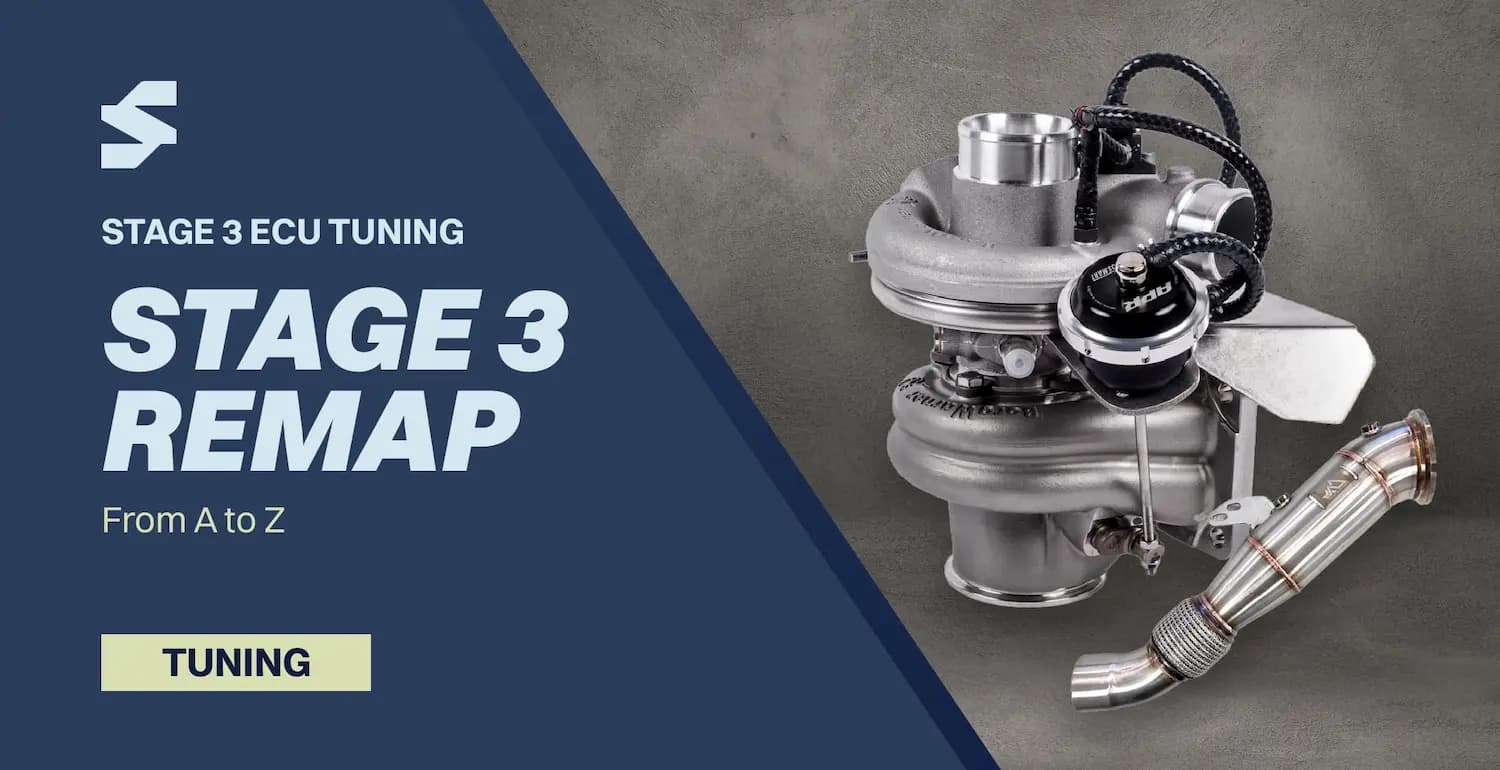
Stage 3 remapping becomes relevant when Stage 2 upgrades can no longer meet the driver’s expectations, in simple terms, when you need significantly more horsepower and torque. Achieving this higher level of power requires modifications inside the engine as well. Upgrades such as a performance camshaft, a larger turbocharger, and reinforced internal components fundamentally change the engine’s breathing and power potential, allowing for a more precise and customized remap based on the new hardware.
The goal of this stage is to extract the maximum possible output from the engine beyond factory limitations. This article explains the role and necessity of these modifications and how Stage 3 remapping works in relation to extensive hardware upgrades.
In short, Stage 3 remapping is a fully custom tuning setup designed for engines with substantial internal and external modifications, such as a larger turbo or increased engine displacement, in order to achieve maximum performance.
Differences Between Stage 1, Stage 2, and Stage 3 Remapping:
As mentioned in the Stage 2 tuning article, Stage 1 remapping typically requires no hardware changes. In most cases, a series of basic maintenance tasks and minor technical checks, followed by a software recalibration, are enough to achieve an effective Stage 1 tune.
However, both Stage 2 and Stage 3 remaps require software changes. The clear distinction is that Stage 2 tuning relies on light hardware upgrades combined with software adjustments, whereas Stage 3 is a different level entirely. As explained earlier, Stage 3 requires extensive and heavy internal hardware modifications, such as a performance camshaft, a larger turbocharger, strengthened internal engine components, and other upgrades suitable for your engine type and condition.
Hardware Requirements for Stage 3 Remapping:
Anything added beyond typical Stage 2 components, usually involving internal engine modifications, falls under Stage 3. The exact parts needed depend on your tuner’s recommendations and the level of performance you are aiming for.
For example, in a naturally aspirated engine, achieving higher performance may require camshafts with increased lift and duration, or stroking the engine to increase displacement. In a turbocharged engine, a larger turbocharger and forged pistons may be used to handle higher boost pressures.
Common hardware used in a Stage 3 setup includes:
- Turbocharger upgrade
- Forged pistons
- Performance camshaft
- Larger injectors and MAF sensor
- Upgraded spark plugs and coils
and other components depending on the engine and performance goals.
The Role of the ECU in Stage 3 Remapping
To put it very simply, performing a Stage 3 remap on a stock factory ECU is a highly complex task that requires both experience and specialized tools. Many people wonder why Stage 3 tuning is so different.
The answer is straightforward: all major engine parameters and characteristics have changed, and the stock ECU has no predefined values for the new setup.
For example, in a Stage 2 tune you typically modify only three or four key parameters, such as airflow or AFR, and with some knowledge and experience you can calibrate them properly. But in Stage 3, when the values, percentages, and operating ranges of multiple engine parameters and actuators are fundamentally altered, you must first define entirely new specs and data.
For instance, when using larger injectors or a aftermarket MAF sensor, the very first step is to input their specifications into the ECU maps, a process known as injector scaling or MAF scaling. And that’s only one part of the work. As the number of hardware changes increases, the overall calibration becomes significantly more complicated, and only a skilled and experienced tuner can properly manage it.
Advantages of Stage 3 Remapping
No Need for a Standalone ECU
In many Stage 3 builds, the factory ECU, when properly and professionally recalibrated, can fully manage all hardware upgrades without the need for a standalone ECU. This is especially important for modern engines from brands like BMW, Mercedes, Volkswagen, and Audi, whose factory ECUs use complex calibrations and multiple safety systems that most standalone units cannot support.
Standalone ECUs often struggle with modern technologies such as advanced knock control, multi-stage torque algorithms, electronic fuel pump systems, and smart control modules, which can lead to frequent errors and loss of OEM functionalities.
In contrast, using the stock ECU preserves full compatibility with all sensors, electrical systems, and control modules while also reducing project costs. All factory features, such as safety systems, stability control, and diagnostic functions, remain intact. For these reasons, relying on the OEM ECU with a specialized calibration is the most stable and reliable approach for achieving high power in Stage 3 builds.
No Need for an Engine Swap
Another major advantage of Stage 3 tuning is that you typically don’t need to swap the entire engine to reach high power levels. By properly upgrading the internal and external engine components, such as a larger turbo, performance camshafts, an upgraded fuel system, and improved cooling, you can reach impressive power figures without replacing the whole powertrain. This not only reduces costs but also preserves the car’s original identity and keeps the tuning process more controlled and predictable.
Ability to Use the Engine’s Maximum Potential
Stage 3 remapping is designed not only to remove factory software limits but also to synchronize the ECU perfectly with all hardware upgrades. This means parameters such as turbo pressure, cam timing, air-fuel ratios, and ECU safety limits are rewritten so the engine can produce the maximum safe power and torque without internal damage.
This transforms the power increase from a simple hardware-boosted improvement into a stable, reliable, and safe performance output while maintaining the longevity of critical engine components.
Disadvantages and Risks
Reduced Engine Longevity
Increasing power beyond factory limits naturally reduces engine lifespan. This is especially noticeable in high-mileage vehicles or those with a history of poor maintenance.
Higher Heat and Knock Risk
Stage 3 setups generate significant heat. Inadequate cooling, a small intercooler, or low-quality fuel can lead to knock, power loss, or even engine damage. High-octane premium fuel and proper environmental conditions are essential.
Significantly Increased Fuel Consumption
Due to higher injector flow rates, increased boost pressure, and richer fuel mixtures, fuel consumption rises considerably compared to lower stages.
Shorter Service Intervals and More Maintenance
Oil, filters, and spark plugs require more frequent replacement. Even small maintenance neglect can cause major problems. High-quality, properly rated engine oil is mandatory.
Less Suitable for Daily Use
Harsher ride quality, louder engine noise, higher fuel consumption, and increased mechanical sensitivity make Stage 3 setups less ideal for city driving or heavy traffic. This stage is better suited for semi-track or performance-focused use.
Possible Emissions or Warranty Issues
In many vehicles, removing or modifying emissions-related components such as GPF or DPF can lead to failed emissions tests or voided warranties.
Which Cars Are Suitable for Stage 3?
Stage 3 should be performed on engines with strong potential for power increases and the ability to handle significant hardware upgrades and higher stress levels. It is ideal for vehicles already running Stage 2 modifications, where the driver seeks substantial gains in power and torque.
This level of tuning is most effective on modern turbocharged engines with advanced ECU management systems, such as the BMW B58, Volkswagen’s EA888 Gen 7, or Mercedes’ M133 / M139 engines found in models like the CLA45 AMG.
In these vehicles, Stage 3 upgrades typically include a larger turbocharger, a stronger fuel system, improved cooling, and reinforced internal components such as camshafts, pistons, and valves. With a professional calibration, the factory ECU can manage all these upgrades while maintaining full software-hardware harmony. This allows the driver to extract maximum power safely and reliably.
Stage 3 is not suitable for weaker engines or engines with limited upgrade potential, as achieving maximum performance without strong hardware support and precise ECU management is simply not feasible.
Cost and Maintenance of a Stage 3 Build
Stage 3 is a high-level, professional upgrade, and naturally, its cost is significantly higher than lower stages. These expenses are not limited to the professional ECU recalibration or the hardware upgrades such as a larger turbocharger, an upgraded fuel system, improved cooling, or reinforced internal engine parts. A major part of the cost also comes from the specialized tuning procedures and equipment required.
Using a dyno for engine testing and calibration, data logging to analyze precise performance parameters, and high-octane fuel to prevent knock and ensure engine safety are all essential components of the process.
Beyond the engine itself, Stage 3 also affects other systems of the vehicle. The increased power output requires a strengthened transmission to reliably transfer torque, as well as upgraded brakes to maintain safety at higher speeds and acceleration levels. Therefore, maintaining a Stage 3 vehicle involves more than routine engine servicing, every component related to performance and safety must be monitored carefully.
Overall, Stage 3 requires a substantial investment, but in return delivers outstanding performance, sharp throttle response, and an exhilarating driving experience, provided that all tuning steps are done professionally and maintenance is performed correctly.
Data Logging for a Stage 3 Remap
Data logging is an essential step in any Stage 3 remap. A Stage 3 file created without data logs is merely a basic startup tune, and even that is often based on assumptions for many parameters, making it risky. For an accurate and safe Stage 3 calibration, precise data logs are absolutely necessary.
But what parameters must be logged?
The required logging parameters depend directly on the new components installed, as well as your vehicle's model and engine type. Stage 3 tuning is not a fixed, predefined process, every case is different, every setup is different, and every car behaves differently. Therefore, you must always consult your tuner beforehand so they can explain exactly what data they need.
Generally speaking, the common parameters required for Stage 3 data logging include:
- Engine speed
- Boost pressureThrottle position
- AFR (lambda)
- Ignition timing and SOI
- Fuel rail pressure
- IAT
- WGDC
- Engine load
- EGT
Some of these parameters apply only to diesel engines, while others apply only to gasoline engines; it depends on your specific setup.
Additionally, many ECU parameters have multiple sub-categories. For example, AFR (lambda) includes target lambda, actual lambda, and base lambda. Your tuner will specify exactly which ones are required.
Finally, in many Stage 3 builds, injectors, MAF or MAP sensors, and the turbocharger are replaced with higher-capacity components. For all such upgrades, you must provide your tuner with the exact specifications so they can perform proper scaling calculations for each new component. Without this information, the tuning process cannot be completed safely.
Real Dyno Case Study
Stage 3 ECU & DSG Calibration for Volkswagen Golf GTI 7.5 (245 HP)
Continental SIMOS 18.10 ECU | DQ381 DSG Transmission | Schiller Tuning Dyno Laboratory
Modern ECU calibration is no longer about simply increasing boost pressure or adding fuel. A professional Stage 3 calibration requires complete integration between engine hardware, ECU strategies, transmission behavior, combustion stability, thermal management, and real-world validation.
In this engineering case study, we present one of the calibration projects completed inside the Schiller Tuning Dyno Laboratory using a Volkswagen Golf GTI Mk7.5 Performance equipped with the Continental SIMOS 18.10 ECU and DQ381 DSG transmission.
Unlike generic "before and after" tuning reports, this project documents the complete engineering workflow—from hardware upgrades and ECU calibration to DSG optimization, dyno validation, and real-world data logging.
Vehicle Specifications
| Parameter | Specification |
|---|---|
| Vehicle | Volkswagen Golf GTI Mk7.5 Performance |
| Engine | EA888 Gen3 2.0 TSI |
| Factory Power | 245 HP |
| ECU | Continental SIMOS 18.10 |
| Transmission | DQ381 7-Speed DSG |
| Fuel | Premium 98 RON |
| Calibration | Custom Stage 3 ECU + Stage 2 DSG |
| Validation | Dyno + Road Data Logging |
Project Objectives
The customer requested a fully engineered Stage 3 package with the following priorities:
- Maximum reliable power
- Faster turbo response
- Improved mid-range torque
- Safe combustion under full load
- Daily drivability
- Smooth DSG operation
- Reliable launch performance
- Long-term engine reliability
Rather than pursuing peak dyno numbers, the primary objective was to create a calibration that could consistently deliver performance while maintaining OEM-level reliability.
Hardware Engine Upgrade for STG3 in Schiller Workshop
Before any calibration work began, the vehicle was upgraded with carefully selected performance components designed to support increased airflow and higher boost pressure.
Engine Hardware
| Component | Installed |
|---|---|
| Cold Air Intake | Performance Intake Kit |
| Turbocharger | Hybrid Stage 3 Turbo Upgrade |
| Charge Pipe | High-Flow Aluminum Charge Pipe |
| Downpipe | High-Flow Performance Downpipe |
| Exhaust System | Cat-Back Performance Exhaust |
| Ignition Coils | High Output Performance Coils |
| Spark Plugs | Colder Heat Range Performance Plugs |
Every hardware modification was inspected before calibration to ensure mechanical integrity and proper installation.
ECU Calibration Strategy for This Stage
Unlike generic "percentage tuning," this calibration was developed using an OEM-style engineering methodology.
Each subsystem was individually analyzed, calibrated, and validated.
The calibration included optimization of:
- Driver Demand
- Torque Model
- Requested Load
- Boost Target
- Wastegate Control
- Ignition Timing
- Lambda Targets
- Knock Control
- Fuel Enrichment
- Turbo Protection
- Thermal Protection
- Exhaust Gas Temperature Protection
- Torque Monitoring
- Torque Intervention
- Fuel Cut Strategies
Special attention was given to maintaining smooth torque delivery throughout the entire RPM range rather than creating aggressive torque spikes that reduce drivability or shorten component life.
Data Logging & Calibration Validation
Every calibration revision was validated using extensive real-world data logging before returning to the dynamometer.
More than simply checking power output, each log was analyzed to verify combustion stability and engine safety.
The following parameters were continuously monitored throughout the tuning process:
| Parameter | Purpose |
|---|---|
| AFR / Lambda | Safe air-fuel ratio |
| Knock Retard | Combustion stability |
| Individual Cylinder Knock | Cylinder balancing |
| Ignition Timing | MBT optimization |
| Boost Pressure | Turbo efficiency |
| Intake Air Temperature (IAT) | Charge cooling efficiency |
| Exhaust Gas Temperature (EGT) | Thermal protection |
| Fuel Pressure | Injector and HPFP stability |
| Wastegate Duty Cycle | Turbo control accuracy |
| Torque Intervention | ECU protection behavior |
Premium 98 RON fuel was used during both road testing and dyno validation to ensure repeatable ignition timing and knock resistance.
DSG Stage 2 Transmission Calibration
Increasing engine torque without recalibrating the transmission would significantly limit the effectiveness of a Stage 3 engine tune.
For this reason, the vehicle also received a complete Stage 2 DSG calibration for the DQ381 transmission.
The transmission calibration included:
| DSG Optimization | Result |
|---|---|
| Increased Clutch Pressure | Higher torque capacity |
| Raised Clutch Torque Limits | Eliminated premature torque reduction |
| Removed Factory Torque Limiters | Full engine torque utilization |
| Faster Upshift Strategy | Reduced shift interruption |
| Faster Downshift Logic | Improved responsiveness |
| Optimized Shift Schedule | Better power delivery |
| Optimized Launch Control RPM | Maximum acceleration consistency |
| Improved Manual Mode Response | Faster paddle shifts |
Launch Control RPM was determined using multiple dyno runs and real-world traction testing to achieve the best compromise between traction, wheel spin, and acceleration.
Dyno Results of Stage3 ECU Calibration of Golf 7.5 Schiller Tuning by Dynojet:
Following calibration and validation, the vehicle was tested on the chassis dynamometer.
Before Calibration
- Wheel Power: 229.9 HP
- Wheel Torque: 323 Nm
After Stage 3 Calibration
- Wheel Power: 344.5 HP
- Wheel Torque: 576.5 Nm
| Measurement | Before | After | Gain |
|---|---|---|---|
| Wheel Power | 229.9 HP | 344.5 HP | +115.6 HP |
| Wheel Torque | 323 Nm | 576.5 Nm | +253.5 Nm |
While peak horsepower increased modestly, the most significant improvement occurred in the mid-range torque curve, where the vehicle spends the majority of its operating time.
This resulted in noticeably stronger acceleration, improved throttle response, and significantly faster in-gear performance.
Calibration Philosophy
One of the defining characteristics of this project is that the final calibration was not limited by maximum boost pressure, but by the safe operating limits of the engine.
Every calibration decision prioritized:
- Combustion efficiency
- Thermal stability
- Knock resistance
- Turbocharger reliability
- DSG durability
- Long-term drivability
This engineering philosophy allows the vehicle to deliver repeatable performance without compromising reliability.
Key Technical Highlights
| Feature | Schiller Tuning Calibration |
|---|---|
| ECU | Continental SIMOS 18.10 |
| Transmission | DQ381 DSG Stage 2 |
| Fuel | Premium 98 RON |
| Calibration Method | Fully Custom |
| Validation | Dyno + Road Data Logging |
| Knock Monitoring | Individual Cylinder Analysis |
| EGT Protection | Active |
| AFR Optimization | Wideband Verified |
| Launch Control Optimization | Dyno Validated |
| Torque Model Calibration | Custom Engineered |
| Turbo Calibration | Stage 3 Hybrid Turbo |
| Daily Drivability | OEM-Like |
Conclusion of This stage of Schiller Tuning project:
This project demonstrates that professional ECU tuning extends far beyond increasing boost pressure or modifying fuel maps.
A successful Stage 3 calibration requires a complete understanding of ECU torque modeling, ignition control, fuel strategy, transmission behavior, combustion dynamics, and thermal management.
By combining custom ECU calibration, Stage 2 DSG optimization, extensive road data logging, and chassis dynamometer validation, the final result delivered a measurable increase in power and torque while maintaining excellent drivability and long-term reliability.
At Schiller Tuning Dyno Laboratory, every calibration is developed using an engineering-first methodology, ensuring that each vehicle is optimized based on real operating conditions rather than generic tuning files or percentage-based map modifications.
Why Schiller-Tuning Is the Best Choice for a Stage 3 Remap
Stage 3 is where every small adjustment can have a major impact on both power and engine durability, which means you need a team with knowledge, experience, and professional equipment all in one place.
At Schiller Tuning, we use advanced dynos, precise data logging, and specialized engine performance analysis tools to fine-tune every parameter; from turbo pressure to AFR and detailed sensor values. This ensures not only maximum horsepower but also perfect harmony between hardware and software, all while maintaining engine reliability.
Choosing us means choosing scientific, safe, and professional tuning at the highest level.
Schiller-Tuning Professional Training Courses for Stage 2 and Stage 3 Remapping
At Schiller Tuning, we don’t just tune engines, we teach the science behind it. Our advanced, professional training courses for Stage 2 and Stage 3 remapping combine theoretical instruction with hands-on practice, including dyno operation, data logging, ECU calibration, and hardware upgrade management.
These courses come with online support and direct communication with expert instructors, enabling participants to handle Stage 3 projects with precision, safety, and full confidence.
Joining these courses equips you with the knowledge and skills every professional tuner needs to deliver maximum performance.
Master the Art of Stage 3 Calibration: Join the Schiller Tuning Academy
Reading about a Stage 3 SIMOS 18.10 calibration is one thing; having the skills to execute it flawlessly is another. The transition from a basic tuner to a Professional Calibration Engineer requires mastering advanced software, interpreting complex data logs, and manipulating individual ECU parameters with absolute precision.
Are you ready to stop relying on generic files and start building your own high-performance calibrations?
At Schiller Tuning, we have translated our 14+ years of dyno-laboratory experience into the ultimate training program. Our ECM Titanium Petrol Training Course is specifically designed for tuners, workshop owners, and motorsport enthusiasts who want to unlock the true science of ECU mapping.
In this comprehensive course, you will learn how to:
-
Navigate and master the ECM Titanium interface.
-
Identify, modify, and optimize complex fuel, ignition, and boost maps.
-
Safely scale parameters for Stage 2 and Stage 3 hardware upgrades (Turbo, Injectors, Exhaust).
-
Apply real-world data logging techniques to validate your tuning files.
Stop guessing. Start engineering. Take control of the ECU and become the expert your clients trust.
👉 Enroll in the ECM Titanium Petrol Calibration Course Today!
Engineering Validation & Technical References
The calibration methodology presented in this case study was developed and validated using professional diagnostic equipment, OEM technical documentation, and industry-standard calibration resources, including:
- Volkswagen AG Official Service Manuals & SSP 522 (EA888 Gen3 & DQ381 DSG)
- Bosch Automotive Handbook
- Bosch Motorsport Technical Documentation
- Autotuner Professional Platform (OBD / Bench ECU Programming & High-Speed Data Logging)
- AEM Wideband UEGO & Knock Detection Systems
- WinOLS Professional Documentation
- ECM Titanium Official Documentation
- Schiller Tuning Dyno Laboratory (Dyno Validation, Data Logging & Calibration Verification)
All Stage 3 ECU and Stage 2 TCU calibrations were validated using real-world dyno testing, high-speed ECU data logging, AFR/Lambda verification, knock monitoring, boost analysis, and thermal management to ensure safe and repeatable performance under premium RON 98 fuel.

About the author