Author:
Schiller Tuning Research Team
By The Schiller Tuning Engineering Team This technical review is curated by our Lead Calibration Engineers, specializing in Bosch ME17/MED17/MG1US architectures. With over 14 years of dyno-validated experience in advanced ECU calibration and TCU optimization, our team defines the engineering standards utilized by Schiller Tuning representatives worldwide.
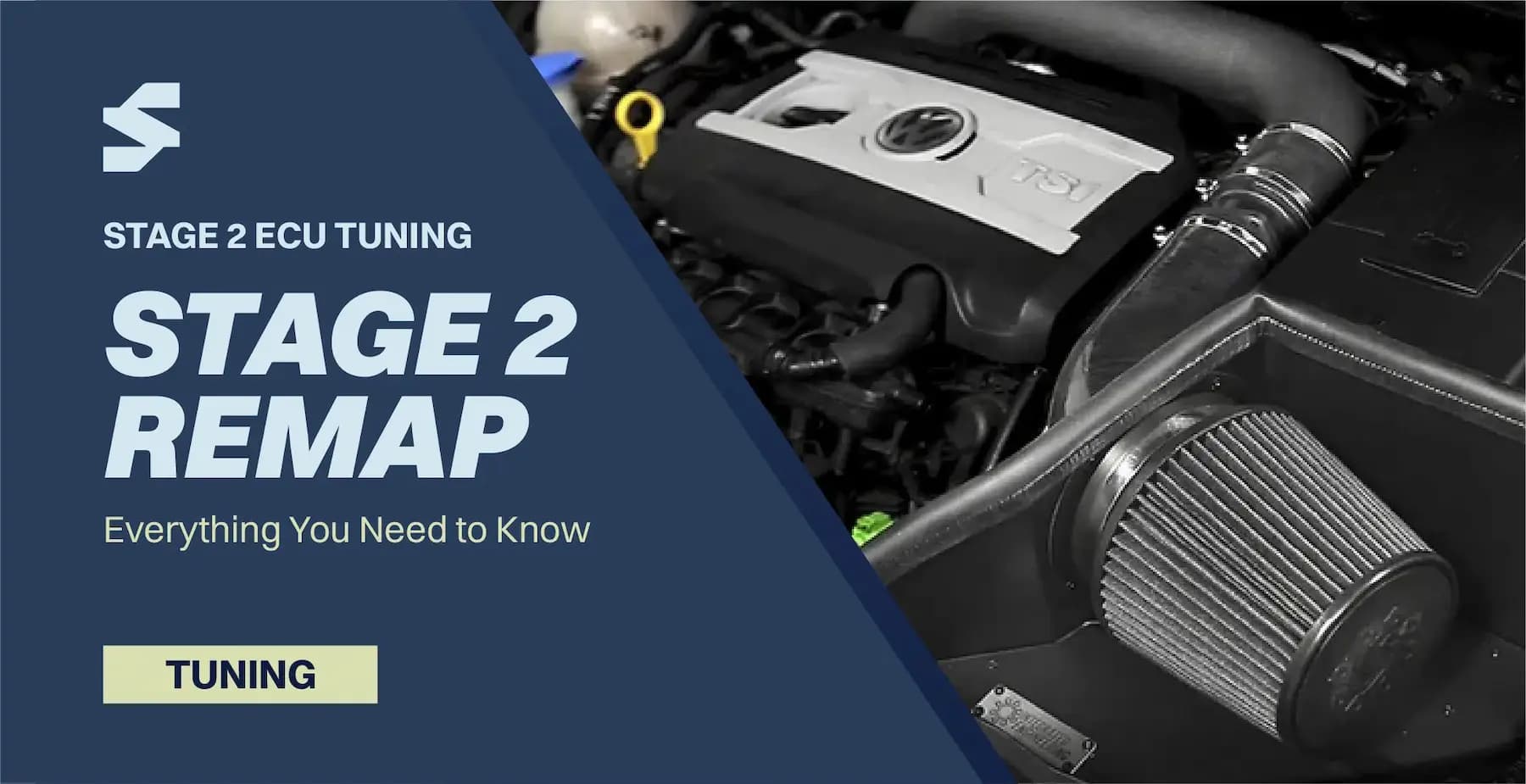
Stage 2 Remap
Every day, many owners of cars, motorcycles, trucks, and vans ask us the same questions: “What is the difference between Stage 1 and Stage 2? or “After a Stage 1 remap, how much power and torque will increase? What about Stage 2, how much gain should we expect?”
In reality, the answers to these questions cannot be summarized into just one or two numbers, and this article is intended to explain exactly that.
What is the difference between Stage 2 tuning and Stage 1 tuning, or even Stage 3 tuning?
What hardware upgrades are required before performing a Stage 2 remap?
Which vehicles are suitable for Stage 2 tuning?
What are the advantages and disadvantages of Stage 2 remapping, and what programmers/tools are needed for it?
What Is a Stage 2 Remap and How Does It Differ from Stage 1 and Stage 3?
To answer the question “What is a Stage 2 remap?”, it’s better to first explain the differences between Stage 1 and Stage 2.
A Stage 1 remap is primarily designed to bring your vehicle closer to the safe limits of its stock components and actuators, without replacing any hardware. These limits are originally set by the manufacturer in the ECU’s base calibration due to factors such as climate conditions, emissions regulations, and component longevity.
However, for a Stage 2 remap, you must make certain hardware upgrades to unlock more potential from the engine. The ECU software must then be recalibrated based on these upgrades. This is exactly where the differences between Stage 1, Stage 2, and Stage 3 become clear.
As mentioned, Stage 1 requires no hardware changes, but Stage 2 and Stage 3 do require hardware modifications.
So, what exact hardware upgrades are needed for a Stage 2 remap?
Stage 2 ECU Remapping Technical Comparison Table:
| Category | Stage 1 Remap | Stage 2 Remap | Stage 3 Remap |
|---|---|---|---|
| Primary Goal | Safe ECU optimization using stock hardware | Maximum performance using bolt-on hardware upgrades | Maximum engine performance with internal engine modifications |
| Hardware Required | None | Downpipe, Intercooler, Intake, Exhaust, Charge Pipes, High Flow Filter | Forged Pistons, Forged Rods, Hybrid/Bigger Turbo, Fuel System Upgrade |
| ECU Calibration Complexity | Medium | Very High | Expert Motorsport Level |
| Turbo Boost Calibration | Factory turbo limit | Optimized for upgraded airflow | Fully custom turbo strategy |
| Fuel System Calibration | Minor injection adjustment | Injection duration, Rail Pressure, Lambda optimization | Full injector scaling & fuel system redesign |
| Ignition Timing | Slight optimization | Knock-based Spark Advance Optimization | Full ignition strategy redesign |
| Torque Strategy | Factory safety limits | Driver Wish + Torque Monitoring + Torque Limiters recalibrated | Complete torque model redesign |
| Lambda / AFR Control | Basic optimization | Wideband AFR tuning for upgraded airflow | Motorsport AFR strategy |
| Airflow Modeling | Stock | Recalculated after Intake / Downpipe / Intercooler installation | Custom VE Model |
| Datalog Required | Optional | Highly Recommended | Mandatory |
| Dyno Testing | Recommended | Strongly Recommended | Mandatory |
| ECU Tools | KESS3, FLEX, AutoTuner | Same programmers | Same programmers |
| ECU Software | WinOLS / ECM Titanium | Professional WinOLS Calibration | Advanced WinOLS Development |
| Typical Development Time | 20-40 min | 40-90 minutes depending on hardware | Several hours to days |
| Typical Gain | 15-30% | 25-45% (vehicle dependent) | Depends on complete build |
| Reliability | Very High | High (if calibrated correctly) | Depends on engine build |
| Suitable For | Daily vehicles | Daily + Performance enthusiasts | Motorsport / Competition |
What Do We Need for a Stage 2 Remap?
To answer this question, we can give a short and practical definition:
Stage 2 requires hardware modifications outside the engine internals that improve the engine’s breathing efficiency, thermal efficiency, and overall operating temperature.
So, there are two key points here:
These modifications do not include engine internals such as pistons, camshafts, etc. They must directly contribute to better airflow or thermal performance.
For example, using a lighter pulley or changing the material of coolant hoses does not improve the engine’s breathing efficiency.
As you may have noticed, we mentioned three factors: volumetric efficiency, thermal efficiency, and optimized operating temperature.
volumetric efficiency simply means the engine can inhale more air more effectively. In simpler terms, more air enters the engine, which leads to higher combustion pressure and more power.
Now the question arises: Which hardware parts improve breathing efficiency and are commonly used for Stage 2 tuning?
And etc.
But there is a missing piece; something many people overlook.
Sometimes individuals or tuners install all the above-mentioned parts on the car and expect at least a 10–20% improvement in efficiency. Yet, surprisingly, the car may actually lose power!
Why does this happen? Why can the engine produce less power than before? What is the missing piece of this puzzle?
The answer is: the ECU.
But how? What is the “magic” behind it that gets ignored?
| Hardware Upgrade | Purpose | ECU Maps That Must Be Recalibrated |
|---|---|---|
| High Flow Downpipe | Reduce exhaust backpressure | Lambda, Boost Control, EGT Protection |
| Performance Intercooler | Lower intake temperatures | Boost Target, Air Temperature Compensation |
| Cold Air Intake | Increase airflow | MAF Scaling, Load Calculation |
| Performance Exhaust | Improve exhaust flow | Torque Model, Lambda |
| High Flow Air Filter | Increase intake efficiency | Air Mass Model |
| Charge Pipes | Reduce boost losses | Turbo Control |
| Turbo Inlet Pipe | Improve compressor efficiency | Boost Request |
Advantages and Disadvantages of Stage 2 ECU Tuning:
A drop in power after installing Stage2-specific aftermarket parts usually happens because of the absence of a proper remap.
When you improve and increase the engine’s airflow, you increase the mass of air entering the cylinders. But this increased air mass is not defined in the ECU’s calibration tables.
As a result, all parameters, fuel injection, ignition timing, and others, fall out of sync, which can cause a noticeable power loss or, in some cases, trigger a check-engine light and force the engine into limp mode.
For example, when the amount of incoming air increases, the Air-Fuel Ratio (AFR) becomes unbalanced and the engine runs lean. Running lean leads to misfires, reduced engine power, and higher combustion temperatures, which can ultimately damage the engine.
And this is exactly where a proper Stage 2 remap, done by a skilled tuner, becomes absolutely essential.
Typical Stage 2 Projects Performed at Schiller Tuning
| Vehicle | ECU | Hardware Installed | Calibration Focus |
|---|---|---|---|
| BMW 320d F30 | Bosch EDC17C50 | Downpipe + Intercooler | Torque Model + Boost |
| VW Golf GTI MK7 | Bosch MED17.5 | Intake + Downpipe | Ignition + Lambda |
| Audi A4 2.0 TFSI | MED17 | Intake + Exhaust | Knock Control |
| Mercedes C220 CDI | Delphi CRD3 | Downpipe | Rail Pressure |
| Alfa Romeo Giulietta | Marelli 8GM | Intake + Intercooler | Driver Wish |
| Hyundai i30N | Continental SIM2K | Intake + Turbo Inlet | Boost Control |
| Nissan Patrol Y62 | Hitachi ECU | Intake + Exhaust | Torque Strategy |
| Toyota Hilux 2.8 | Denso Gen2 | Intercooler + Exhaust | Injection & Rail Pressure |
Advantages of Stage 2 ECU Tuning
Using the words “advantages” or “disadvantages” for a Stage 2 remap isn’t entirely accurate, because a Stage 2 tune is something you need after installing the aftermarket hardware mentioned earlier; its purpose is simply to unlock the proper power and torque potential of those upgrades.
With that in mind, and with a bit of clarification, we can summarize the benefits as follows:
- Increasing the engine’s true power and torque (according to the specifications of the new hardware)
- Preventing check-engine lights, limp mode, and DTC faults
- A better overall driving experience
- Improved initial acceleration
- Ability to enable specialized features such as pop & bang, launch control, and display calibration
- Precise AFR (Air–Fuel Ratio) adjustment
Given these points, there aren’t really any inherent disadvantages to a proper Stage 2 remap, unless you leave your vehicle in the hands of an inexperienced tuner. In that case, you may end up with multiple DTCs, check-engine lights, or even power and torque numbers lower than stock on the dyno!
Of course, voiding the vehicle’s warranty can also be considered a drawback, although this is something you already accept when installing aftermarket performance parts.
How Is a Stage 2 Remap Performed and What Programmers Are Needed?
For a Stage 2 remap, you don’t need any special or unusual programmer. In fact, the same tuning tools used for Stage 1 can be used to read the ECU file. The differences lie in the tuning techniques and calibration requirements between the various stages, not in the programmer itself.
As explained earlier, the first step is to read the ECU software using common ECU tuning tools such as Autotuner, KESS3, bFlash, and etc.
After reading the file, you simply send the extracted file to our file service.
At this stage, you must also attach a list of all modifications made to the engine or transmission, so we can prepare a custom file specifically for your vehicle.
If you are a professional tuner and want to extract the maximum possible power, you should definitely send us datalogs. By analyzing the engine’s behavior through your datalog, our specialists can calibrate your maps with the highest precision and safety.
(We can create a Stage 2 file without datalogs, based on your new hardware specs and vehicle model, but tuning with datalogs is 100% safer and dramatically reduces risk.)
Once we receive the file, our specialists typically need about 40 to 90 minutes to create a fully customized Stage 2 remap for your vehicle.
And if you are interested in learning the correct, professional Stage 2 tuning method, the way we perform it at Schiller Tuning, you can contact us through this link.
| Validation Tool | Why It Is Used |
|---|---|
| Dyno Test | Verify Power & Torque |
| Wideband Lambda | AFR Accuracy |
| Data Logging | Real Driving Validation |
| EGT Monitoring | Exhaust Temperature Safety |
| Boost Logging | Turbo Verification |
| Rail Pressure Logging | Fuel System Validation |
| Knock Monitoring | Engine Protection |
Stage 2 Remap Tuning Price
The price of a Stage 2 file at Schiller Tuning depends on several factors, including the type and number of aftermarket parts installed, your vehicle’s brand, model year, mileage, and also whether the check-engine light is on or if there are any active DTCs. However, the minimum price for a Stage 2 file at Schiller Tuning is €150.
Mercedes-Benz CLS 500 Stage 2 Custom ECU Remap | Shiller Tuning Dyno Project Study
Vehicle Overview
This Mercedes-Benz CLS 500 was brought to the Shiller Tuning workshop by an owner looking for significantly stronger performance without compromising everyday drivability or reliability. Rather than using a generic tuning file, the vehicle underwent a complete mechanical inspection followed by a custom Stage 2 ECU calibration developed specifically for its hardware configuration.
Every step of the project was completed in-house, from pre-tuning diagnostics and hardware upgrades to dyno validation and final ECU calibration.
Vehicle Specifications
| Item | Specification |
|---|---|
| Vehicle | Mercedes-Benz CLS 500 |
| Engine | 4.7L Twin-Turbo V8 |
| ECU Calibration | Custom Stage 2 |
| Workshop | Shiller Tuning |
| Fuel | Premium High-Octane Petrol |
Initial Dyno Baseline
Before any modifications were performed, the vehicle was tested on our chassis dynamometer to establish a reliable performance baseline.
Factory Dyno Results
- Power: 342 HP
- Torque: 579 Nm
The engine was healthy, boost pressure was stable, fuel trims were within specification, and no mechanical faults were detected before calibration.
Hardware Upgrades
To support a Stage 2 ECU calibration, several supporting modifications were installed before any software changes were made.
Installed Components
- Performance Cold Air Intake
- High-flow Downpipes
- Premium High-Octane Fuel
- Complete ECU Health Check
- Custom Stage 2 ECU Calibration by Shiller Tuning
These modifications improve airflow through the engine while reducing exhaust backpressure, allowing the calibration to safely increase engine efficiency and power output.
Custom ECU Calibration
Unlike pre-made tuning files, this vehicle received a fully custom calibration developed specifically for its hardware configuration.
The ECU software was optimized by adjusting multiple calibration strategies, including:
- Torque model optimization
- Turbocharger boost control
- Ignition timing calibration
- Air-Fuel Ratio (Lambda) optimization
- Driver demand mapping
- Load calculation refinement
- Throttle response optimization
- Torque limit management
Every calibration change was validated through dyno testing and post-flash verification.
Final Dyno Results
Following calibration, the vehicle returned to the dynamometer for validation testing.
| Measurement | Stock | Stage 2 |
|---|---|---|
| Power | 342 HP | 468 HP |
| Torque | 579 Nm | 779 Nm |
Performance Gain After Schiller Tuning Custom Remapping
- +126 HP
- +200 Nm Torque
The final calibration produced substantially stronger mid-range acceleration together with improved throttle response and smoother power delivery across the rev range.
Engineering Notes Based on Our Experince in Schiller Tuning
This project highlights an important principle in professional ECU tuning:
Software alone does not create reliable performance.
Stage 2 calibration depends on supporting hardware, accurate diagnostics, high-quality fuel, and proper dyno validation. Every calibration should be tailored to the vehicle's actual mechanical condition rather than relying on generic files or advertised power figures.
At Shiller Tuning, every project follows the same engineering workflow:
- Mechanical inspection
- Baseline dyno testing
- Hardware verification
- Custom ECU calibration of Schiller Tuning
- Dyno validation
- Final quality checks
This process helps ensure that performance gains remain repeatable, reliable, and safe for long-term operation.
Results Summary
This Mercedes-Benz CLS 500 demonstrates how a properly engineered Stage 2 ECU remap, combined with the correct supporting hardware and validation process, can deliver significant improvements in both power and torque while maintaining OEM-level drivability. Rather than relying on generic software, the calibration was developed specifically for this vehicle using real-world workshop experience, chassis dyno testing, and iterative refinement.
Results shown in this case study were achieved on this specific vehicle with the listed hardware modifications, premium fuel, and a custom calibration. Performance gains may vary depending on vehicle condition, fuel quality, hardware configuration, and environmental condition
How Much Horsepower Will Stage 2 Add?
This is one of the questions we get asked most frequently. To be completely honest, after installing new aftermarket parts, no two vehicles are ever identical. There are many changing variables, which makes providing any exact, or even estimated number, meaningless.
So, the best approach is to measure the results on a dyno and analyze the datalogs, rather than relying on guesses or assumptions.
Which Vehicles Can Receive a Stage 2 Remap?
To be honest, it makes no difference to us!
Even if you’ve installed aftermarket parts on your farm tractor and you have a datalog, that’s enough; we can create the best possible file for you!
We’ve done Stage 2 work on trucks, vans, tractors, and even various types of competition vehicles.
However, in most cases it’s car owners who request Stage 2 remapping, and the reason is clear: installing aftermarket performance parts is far more common on cars.
Is stage 2 Remap safe?
A Stage 2 remap, when performed correctly by a professional tuner, is not only safe but can actually make the engine operate more safely.
The reason is that installing aftermarket performance parts alters many of the engine’s factory parameters. If the stock ECU calibration is left unchanged, the air-fuel ratio becomes unstable, the mixture may run lean, exhaust gas temperatures (EGT) can rise significantly, and the risk of knock increases.
However, when a proper Stage 2 remap is carried out by an experienced tuner, all new parameters are recalibrated in the ECU. This ensures that the engine operates safely while also achieving its maximum performance potential.
is stage 2 remap road legal?
- Stage 1 → usually road legal
- Stage 2 → track use / off-road use in most places
Stage 2 tuning is generally not road legal in most countries because it typically includes a high-flow downpipe, catalytic converter modification or removal, and higher boost, which often violates emissions, noise, and type-approval regulations. While enforcement and rules vary by region, Stage 2 setups usually fail emissions or OBD inspections and are therefore sold as “off-road or track use only.” In rare cases, a Stage 2 car can be road legal if it uses fully certified (TÜV or CARB-approved) parts, retains emissions compliance, and passes all local inspections, but this is uncommon and highly dependent on local laws.
Contact us: Contact us easily via WhatsApp at +968 90 966 642
Email: [email protected] We’re here to help!
Engineering Validation Methodology
The Stage 2 ECU calibration for the Mercedes-Benz CLS 500 (W218) equipped with the Bosch MED17.7.x engine management system was developed and validated using OEM technical documentation, professional ECU programming tools, chassis dynamometer testing, and real-time engine data analysis. The calibration process followed a validation workflow that included ECU programming, dyno verification, boost and ignition optimization, lambda monitoring, and thermal management analysis to ensure safe, repeatable, and reliable performance.
Technical References
The engineering decisions presented in this case study are based on the following technical documentation and manufacturer resources:
- Mercedes-Benz USA Technical Information – Technical Introduction Manual: New Generation V6/V8 Engines (M276/M278) (OEM torque model, Bosch MED17.7.x control strategies, ignition architecture)
- K&N Engineering – High-Flow Air Intake Technical Datasheet (Part No. 33-2474) (airflow characteristics and volumetric efficiency)
- Supersprint Italy R&D – Performance Downpipe Technical Documentation (Part No. 848411) (exhaust flow optimization, backpressure reduction, and EGT management)
- AutoTuner Technologies – OBD/Bench Programming Protocol Documentation for Bosch MED17.7.x (secure flashing procedures and checksum validation)
- Schiller Tuning Dyno Laboratory – Internal calibration reports, chassis dynamometer measurements, ECU data logs, and validation records for Project MB-CLS500-ST2
Validation Equipment
The ECU calibration and validation process was performed using professional workshop equipment, including:
- AutoTuner Professional (OBD/Bench ECU Programming)
- 4WD Chassis Dynamometer (Power & Torque Validation)
- Wideband Lambda Monitoring System
- ECU High-Speed Data Logging
- Boost Pressure & Ignition Timing Analysis
- Exhaust Gas Temperature (EGT) Monitoring
- Schiller Tuning Calibration Verification Procedures
All performance figures presented in this case study were validated through controlled dynamometer testing, ECU telemetry analysis, and repeated verification runs to ensure calibration accuracy, component safety, and long-term reliability.

About the author