
Written from the author’s own account (Louie Taylor) and edited by Schiller Tuning, which sells the course mentioned in this story. The technical review was carried out by the Schiller Tuning team under Sina’s supervision. Dyno figures are as reported by the author.
I’m Louie Taylor, an SUV repair and tuning specialist based in Sydney, Australia. I run a small workshop where I repair and tune SUVs, mostly Japanese brands such as Nissan and Toyota. Most of my customers use their vehicles for adventure, travel or off-roading, so demand for tuning kept growing. That is why I decided to learn ECU remapping myself.
This is the story of my second remapping project: a Toyota Land Cruiser Prado 250 with the 2.4-litre turbo petrol engine. It is a GCC-specification car that was imported to Sydney. It was hard. The tool I tried first could not read the ECU, the ECU could not be read through the OBD port, and I needed more detailed map data than I could work out alone, so Sina, my support engineer at Schiller Tuning, prepared a custom Mappack for me. In the end the owner was very satisfied. On the Dynojet, the car went from about 193 hp and 347 N·m at the wheels to 215 hp and close to 405 N·m.
Project at a glance
| Item | Detail |
|---|---|
| Tuner and author | Louie Taylor, SUV repair and tuning specialist, Sydney, Australia |
| Vehicle | Toyota Land Cruiser Prado (250 Series), GCC-specification, imported to Sydney; about 10,000 km |
| Engine | 2.4-litre turbocharged four-cylinder, code T24A (full designation T24A-FTS) |
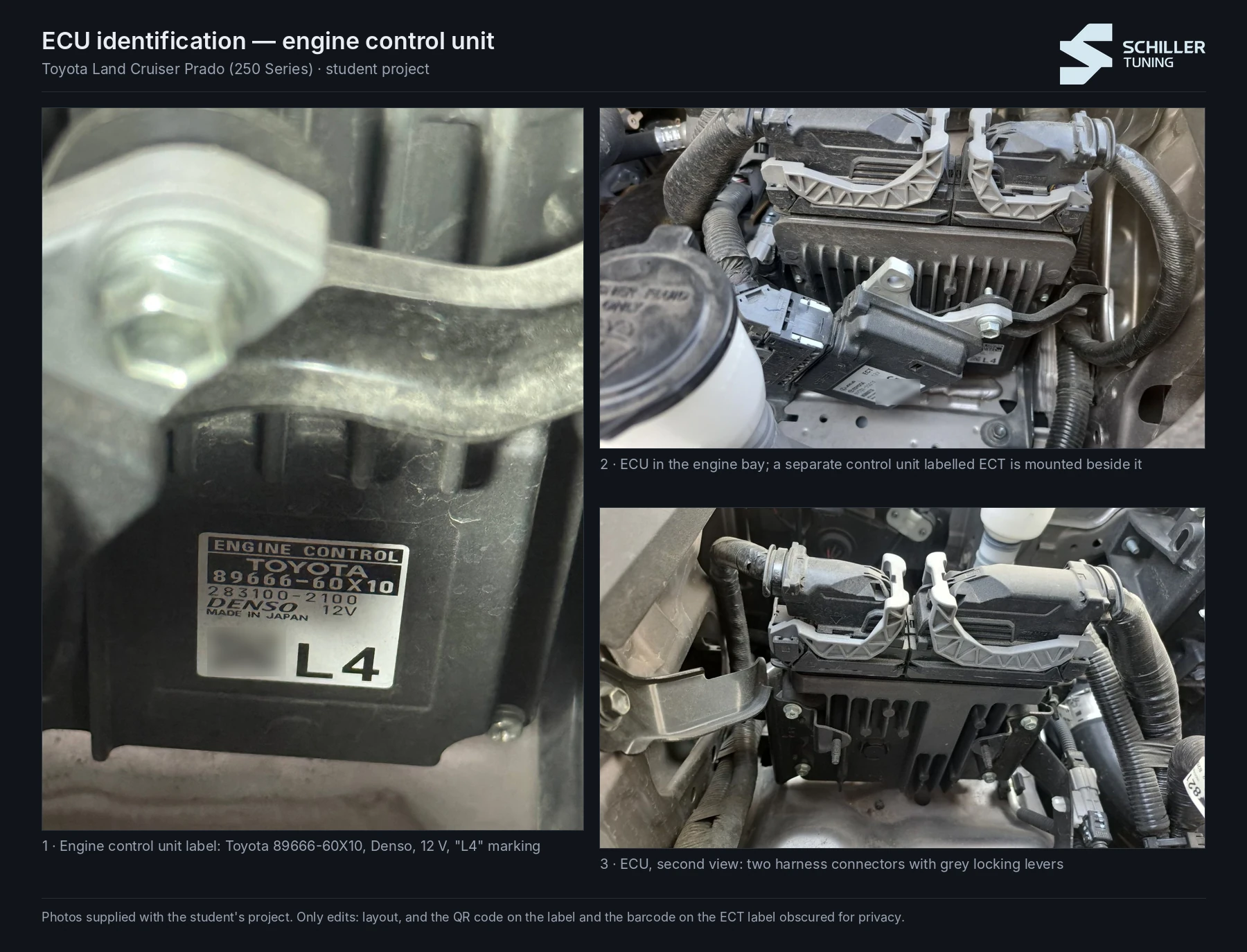
| ECU | Denso-made Toyota engine control unit; the label reads Toyota 89666-60X10 |
| Owner’s complaint | Not satisfied with pulling power and acceleration |
| Baseline test | Dynojet (2WD, single-axle dyno), vehicle’s Dyno Mode with 2H (rear-wheel drive), 4th gear, 91-octane petrol |
| Reading the ECU | Autotuner (no support for this ECU at the time), then PCMflash Module 95 by pinout with a Scanmatik interface |
| Calibration | WinOLS, using a custom Mappack prepared by Sina, Schiller Tuning support engineer |
| Technical review | Schiller Tuning team, under Sina’s supervision (technical review, calibration strategy, data verification) |
| Reported wheel figures | About 193 hp and 347 N·m before; 215 hp and close to 405 N·m after |
Why the owner came to me
The Prado belongs to one of my old clients. He told me he was not satisfied with its pulling power and acceleration. The reason seemed clear to me: before this car he owned the previous generation of the same body and chassis, a Prado with the 1GR-FE engine, so the difference was obvious to him.
For context, the 1GR-FE is a 4.0-litre V6, while the Land Cruiser 250’s T24A-FTS is a 2.4-litre turbocharged four-cylinder.
The car itself is a GCC-specification model, built for the Gulf Cooperation Council markets in the Middle East, and it was imported to Sydney. That is why it is a petrol model. Toyota’s launch announcement lists the non-hybrid 2.4-litre turbo for markets including the Middle East, while the Prado 250 announced for Australia used a 2.8-litre diesel.
Starting point: a scan and a baseline dyno run
The car had only about 10,000 km on it, so I started with a diagnostic scan. It showed no specific fault codes or issues. After that we put the car on the dyno to see its real power and torque.
A few details about the test. The tank held 91-octane petrol, and we ran the car in 4th gear on a Dynojet. The dyno facility had a 2WD, single-axle dyno, not a full 4WD dyno, so the drive had to go to the rear wheels only. I took the car out of 4WD and put it in 2H, and we engaged the vehicle’s special “Dyno Mode” to isolate the drive safely and send the power only to the rear wheels (the 2H, rear-wheel-drive configuration). That let the dyno measure wheel power at the rear axle.
To everyone’s surprise the result was only about 193 hp and about 347 N·m. These are wheel figures, meaning the power that reaches the wheels, so they should not be compared directly with a manufacturer’s engine rating. (Toyota’s launch announcement lists 207 kW (281 PS) and 430 N·m for the non-hybrid 2.4-litre turbo.) Still, to me those numbers explained why the owner was unhappy with the car’s pulling power.
Why I wanted to change the air–fuel ratio
One point I learned in the Schiller Tuning course shaped my plan. For this kind of car, especially under heavy-duty use, a 14.7:1 air–fuel ratio at full load makes the exhaust gas temperature (EGT) rise quickly, can push the engine into component-protection mode and makes it more likely to knock.
14.7:1 is the “ideal” mixture for petrol: just enough air to burn all the fuel (engineers call this stoichiometric, or lambda 1.0). A richer mixture, with more fuel than that, can lower combustion temperature. Schiller Tuning’s article on EGT in ECU tuning explains this in more detail, including why a single EGT number needs care.
That is why we decided to move on to tuning the ECU.
Getting the ECU file out
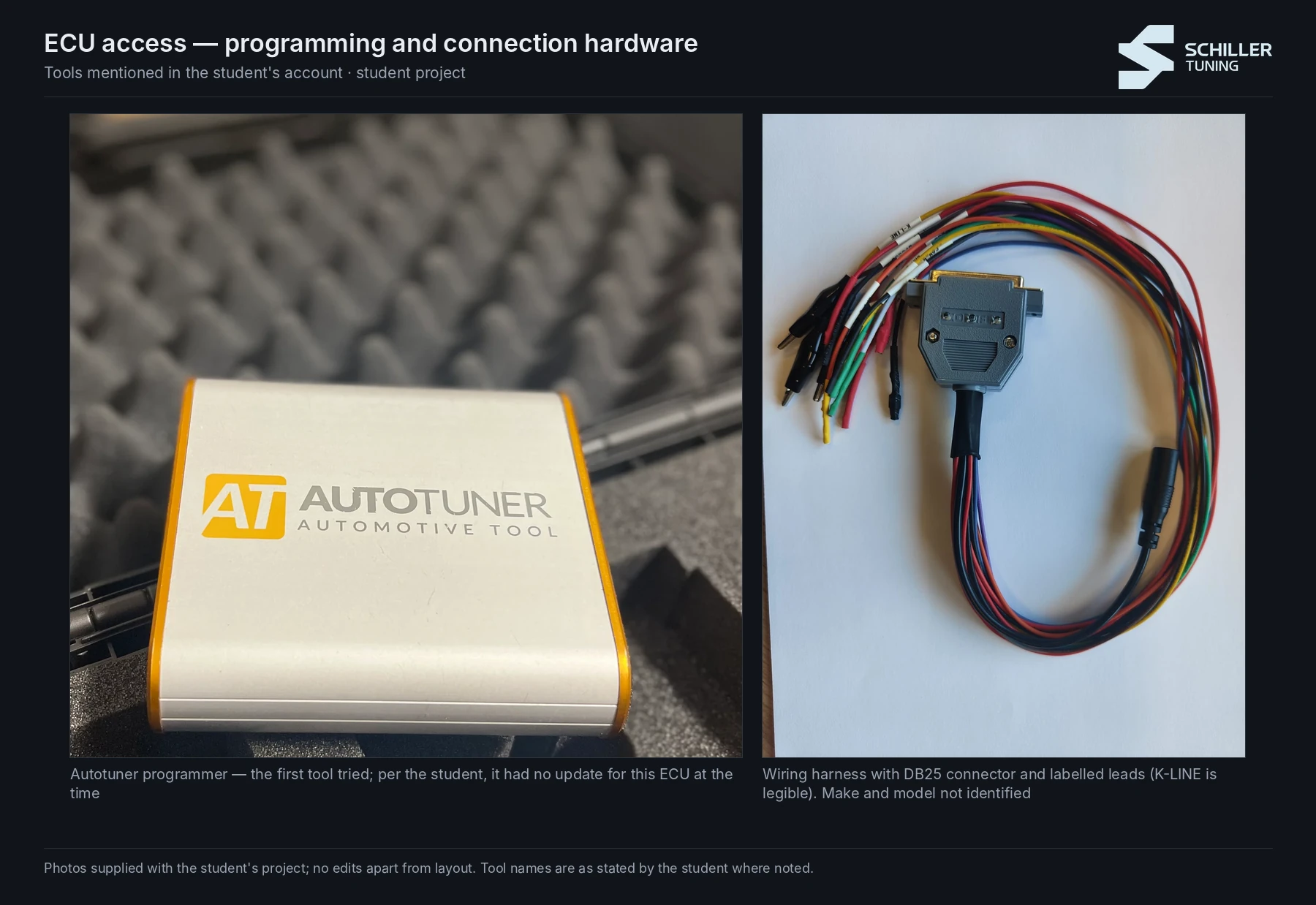
I started with the Autotuner programmer. To my surprise it did not have an update for this ECU yet, so I could not read it. I decided to try another tool: the PCMflash programmer.
The ECU is a Denso-made Toyota unit that PCMflash lists under “Toyota/Lexus generation 4” in its Module 95. PCMflash says that module covers Denso ECUs for Toyota and Lexus models with the 2.4-litre T24A-FTS and 3.5-litre V35A-FTS engines from model year 2022, and that it connects directly to the ECU connector.
In my case the ECU could not be read through the OBD port, so I had to read it using the pinout. I used a Scanmatik interface, connected as shown in PCMflash’s own connection diagram, and read the ECU with Module 95.
From a raw file to a Mappack
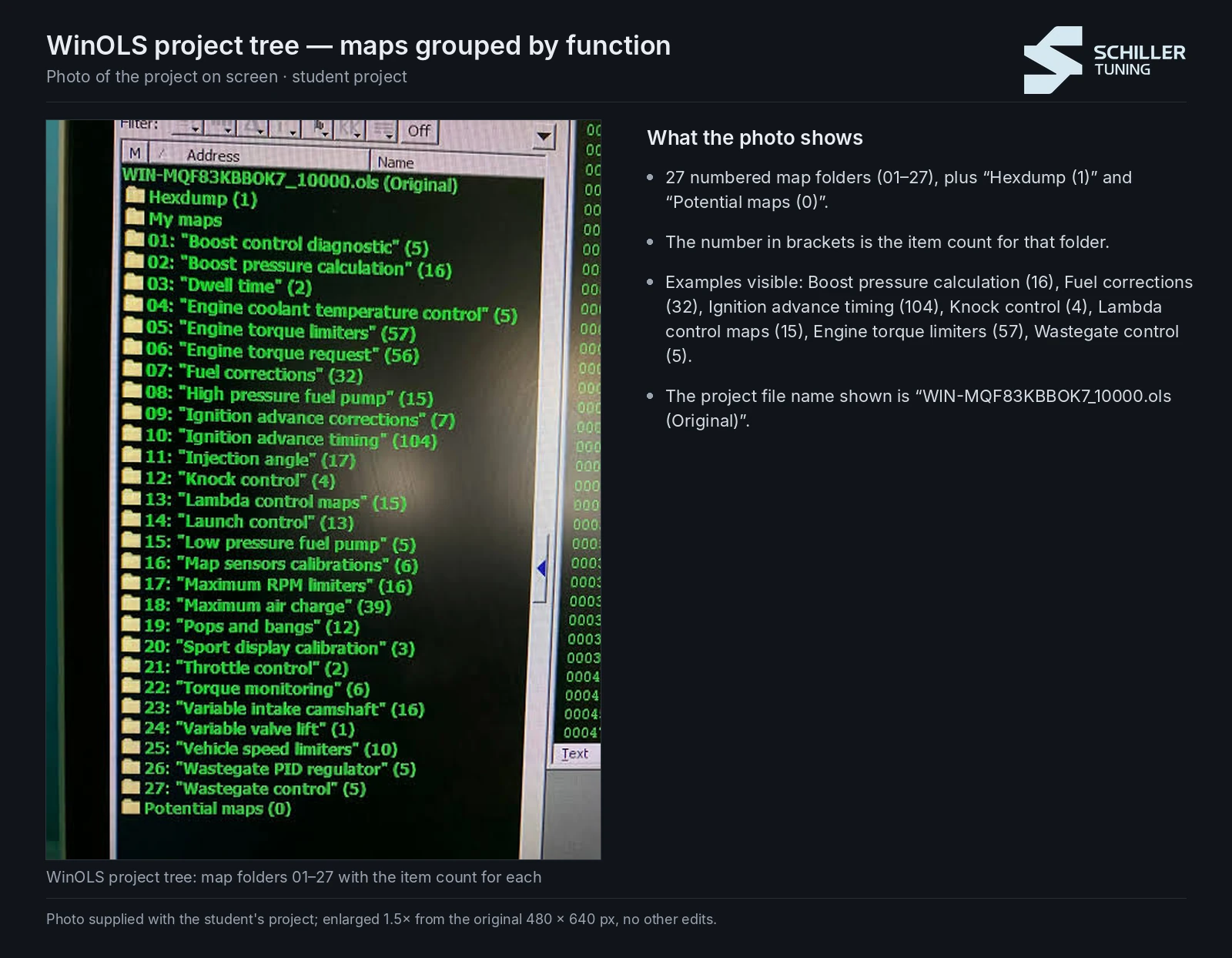
I opened the file in WinOLS. With the training I had done, I could already find many maps, including fuel, ignition and turbo maps, but I needed more precise information than I could pull out on my own. So I sent the file to Sina, my support engineer at Schiller Tuning. After he reviewed it, he said the team could prepare a custom Mappack with very precise data for me.
A Mappack is a file that specifies and labels most of the functional tables in an ECU, as Schiller Tuning’s FAQ puts it. Once I had mine, I could see all the minor and major data in the file. The photo below shows a WinOLS project tree with the maps grouped by function, from boost control and fuel corrections to ignition timing, torque limiters and wastegate control.
With the Mappack, the training I had seen from the Schiller Tuning team and a bit of guidance from Sina, we were able to tune the car the best way we could.
What we changed
Map values depend on the exact ECU software and engine and should not be copied to another car, so this section describes what we worked on rather than listing numbers.
- Fuelling at full throttle. At wide-open throttle (WOT), where the engine is under maximum load, we changed the target air–fuel ratio from 14.7:1 to 13:1. The aim was maximum power and torque while also bringing the EGT down. (Taking 14.7:1 as lambda 1.0, 13:1 is roughly lambda 0.88.)
- The top of the rev range. At the highest RPM we kept the mixture richer still, close to 12:1 (roughly lambda 0.82), so the engine would be well protected at very high revs, even during off-road use and under heavy load.
- Turbo, torque, load and EGT. We also worked on the turbocharger (boost) tables, the torque and engine-load maps and the EGT-related tables, among others.
- Ignition timing. We set the ignition as close to optimum as we could. More advance is not automatically better: if it gets too high the engine can knock, and we did not want it in the knock zone, where pistons and piston rings can be damaged.
- Pedal response. We increased the sensitivity of the driver demand maps, which changes how the engine responds when you press the throttle.
Results: dyno figures and the test drive
After the final adjustments the Dynojet showed 215 hp and close to 405 N·m at the wheels.
| Wheel measurement (Dynojet) | Baseline | After the remap |
|---|---|---|
| Peak power | about 193 hp | 215 hp |
| Peak torque | about 347 N·m | close to 405 N·m |
| Full-throttle air–fuel ratio | 14.7:1 | 13:1, close to 12:1 at the highest RPM |
Figures as reported by the author, Louie Taylor. Baseline test: Dynojet (2WD, single-axle), Dyno Mode with 2H, 4th gear, 91-octane petrol.
After that we went for a test drive together with the owner. The car now had very good torque in the mid-range. Because we had increased the sensitivity of the driver demand maps, the throttle response was better too, and the small delay I had noticed at the start of the pedal travel was gone. The owner was very satisfied with the remap.
What these results do and do not show
- They are wheel figures from one 2WD dyno, with the car in Dyno Mode and 2H, in a before-and-after comparison. The weather conditions, the correction factor and the exact conditions of the final run are not given here.
- This write-up has no data logs. Knock, EGT and boost were not recorded here, so the engine-protection reasoning describes what we aimed for, not measured proof. I believe the settings are safe for this engine, but one dyno comparison and one test drive cannot prove long-term reliability.
- The mid-range torque and pedal-response comments are our impressions from one test drive.
- All of this applies to this GCC-specification car, its ECU software and the 91-octane petrol used. Do not copy the changes to another vehicle. Rules on engine modifications, emissions and warranty differ between countries and states, so check what applies to you.
What I learned
- Not every programmer supports every new ECU. When the first one did not, I switched to another tool.
- Some ECUs cannot be read through the OBD port. This one had to be read through the pinout.
- Finding the maps is not the same as having precise data for each one. That is where the Mappack and the support team helped me.
- Mixture and ignition choices should match how the car is used: richer at the top of the rev range for heavy load and off-road driving, and ignition kept away from knock.
The course and the support behind the project
I bought Schiller Tuning’s petrol remapping course after searching the internet and watching many videos without finding enough real information. After watching it I still had many questions, and the support team guided me precisely and correctly. I found the support friendly, accurate and quick to respond, and I value that it is lifetime support. The Prado was only my second ECU remap, and the team’s help was a big part of getting it done well.
The course is built around WinOLS. Its curriculum lists fuelling tables, spark advance control and knock limits, turbo maps and lessons on using Mappacks: the same areas I worked on here.
Want to develop your skills in this area? Explore the WinOLS Remapping & ECU Tuning Course (Petrol) to see the full curriculum, the Mappack lessons and the live mentoring sessions. I am very grateful to the Schiller Tuning team for their help and support.
Frequently asked questions
Can this Toyota ECU be read through the OBD port? Not in my project. I had to read it through the pinout with PCMflash Module 95. PCMflash’s own notes describe a direct connection to the ECU connector for the T24A-FTS and V35A-FTS ECUs, while some other Toyota ECUs, such as the 2.0-litre M20A-FKS and M20C-FKS units, are listed for reading through the OBD connector. The method depends on the ECU.
Is wheel horsepower the same as the manufacturer’s rating? No. A manufacturer rates the engine’s output. A chassis dyno measures what reaches the wheels after drivetrain losses, and dynos and correction methods differ, so compare like with like: wheel figures from the same dyno, before and after. Schiller Tuning’s dyno course covers wheel versus engine power and how dyno graphs are read.
Why run richer than 14.7:1 at full load? A richer mixture can help control exhaust gas temperature under load, and ECUs can also adjust lambda, boost or ignition timing as component protection. The right target depends on the engine, fuel, turbo and hardware, so the 13:1 and 12:1 figures belong to this project only.
Sources and further reading
- Toyota Global Newsroom: Land Cruiser 250 powertrains (2 August 2023)
- PCMflash: Module 95, Toyota/Lexus generation 4
- Schiller Tuning FAQ: What is a Map Pack?
- Schiller Tuning: What is EGT and Why It’s Important in ECU Tuning?
- Schiller Tuning: Dynamometer Testing and Dyno Graph Analysis for Engine Tuning
- CarExpert: 150 Series Prado powertrain (1GR-FE, 4.0-litre V6)
- Chasing Cars: New Toyota Prado detailed for Australia (2.8-litre diesel)