Written from the author’s own account (Imran Malik) and edited by Schiller Tuning, which sells the courses mentioned in this story. The technical review was carried out by the Schiller Tuning team under Alex’s supervision. No dyno was used, so the results are the owner’s impressions from a test drive.
I’m Imran Malik. I own a garage in Dubai where I repair and tune German cars, especially Mercedes-Benz and BMW. About six months ago I took Schiller Tuning’s petrol remapping course, which uses ECM Titanium. I kept practising afterwards and decided to write my own remaps instead of buying file services from tuning companies.
This is the story of a friend’s Mercedes-AMG GTR. After a downpipe was fitted, the check engine light came on with P0420. The car was expensive and its ECU could not be replaced or recovered if anything went wrong, so I took a full bench backup first, then edited the maps in ECM Titanium with help from my mentor, Alex. I had no dyno, so there are no power figures: on a test drive the owner felt much better top-end acceleration and liked the pops, bangs and backfire.
Project at a glance
| Item | Detail |
|---|---|
| Tuner and author | Imran Malik, garage owner (German-car repair and tuning), Dubai, UAE |
| Vehicle | Mercedes-AMG GTR (C190), 2019; 7-speed dual-clutch automatic, rear-wheel drive |
| Engine | 4.0-litre twin-turbo V8, code M178; factory rating 430 kW (585 PS) and 700 N·m |
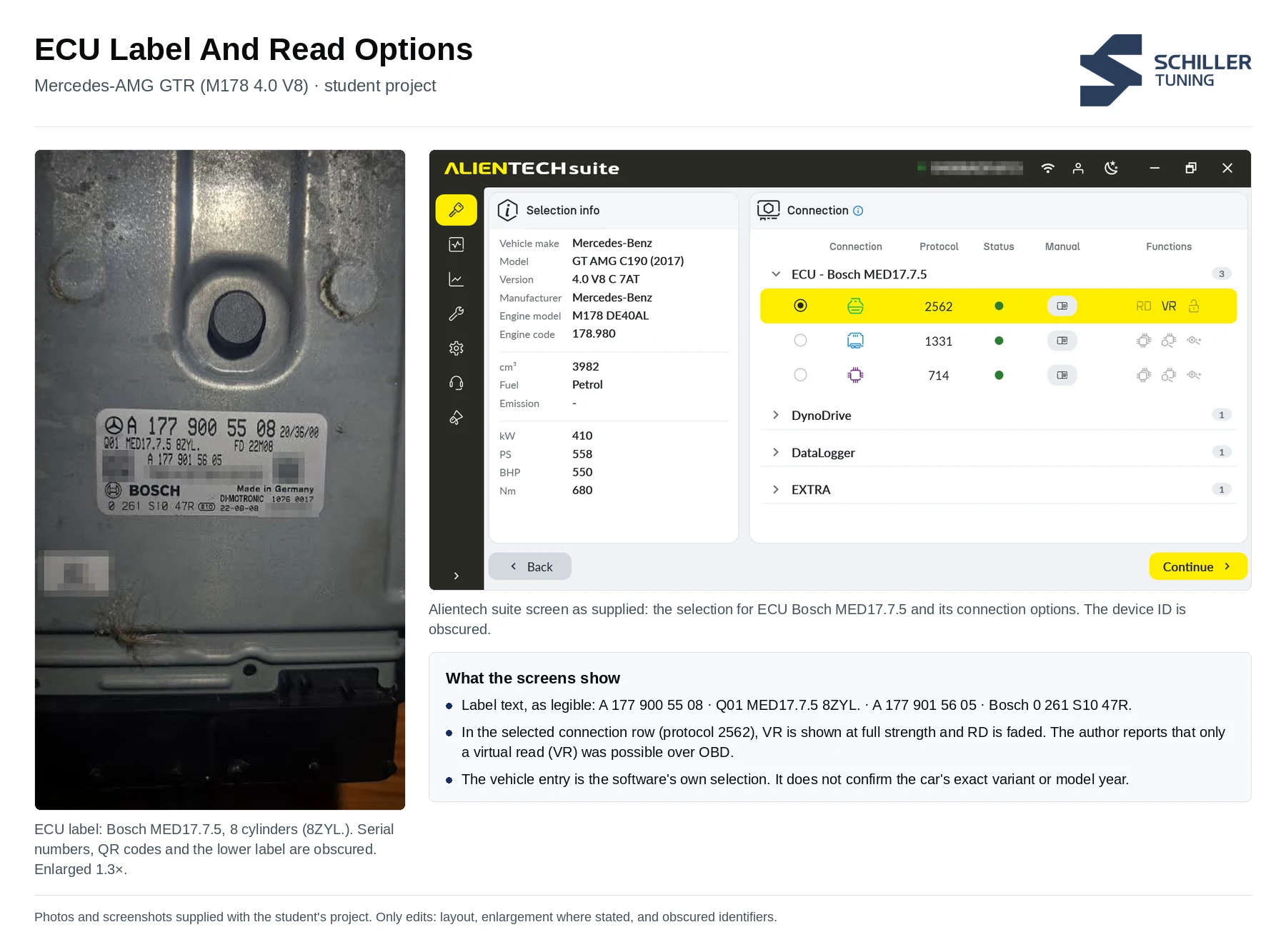
| ECU | Bosch MED17.7.5; the label reads Mercedes-Benz A 177 900 55 08 and Bosch 0 261 S10 47R |
| Owner’s goal | More engine power, safely |
| Hardware | Downpipe (a Weistec unit) fitted before the remap |
| Reading the ECU | Alientech KESS3 Master in bench mode with the KESS3 bench multi-wire cable (144300KBNC), using the ECU pinout diagram; over OBD only a virtual read (VR) was offered |
| Backup | Full bench backup of the micro, the flash and the EEPROM |
| Calibration | ECM Titanium, with mentoring from Alex, Head of the Training Department |
| Testing | No dyno; a test drive with the owner |
| Technical review | Schiller Tuning team, under Alex’s supervision |
Factory figures from CarExpert’s 2019 Mercedes-AMG GT R specifications. ECU numbers as read from the label.
Why the owner came to me
The AMG GTR belongs to a friend of mine, and all of its earlier servicing had been done at my workshop. He wanted to increase the engine’s power safely. The car was very expensive, so we would not have been able to replace or recover the ECU if it got damaged. That one fact shaped every decision that followed.
Planning a safe tune without a dyno
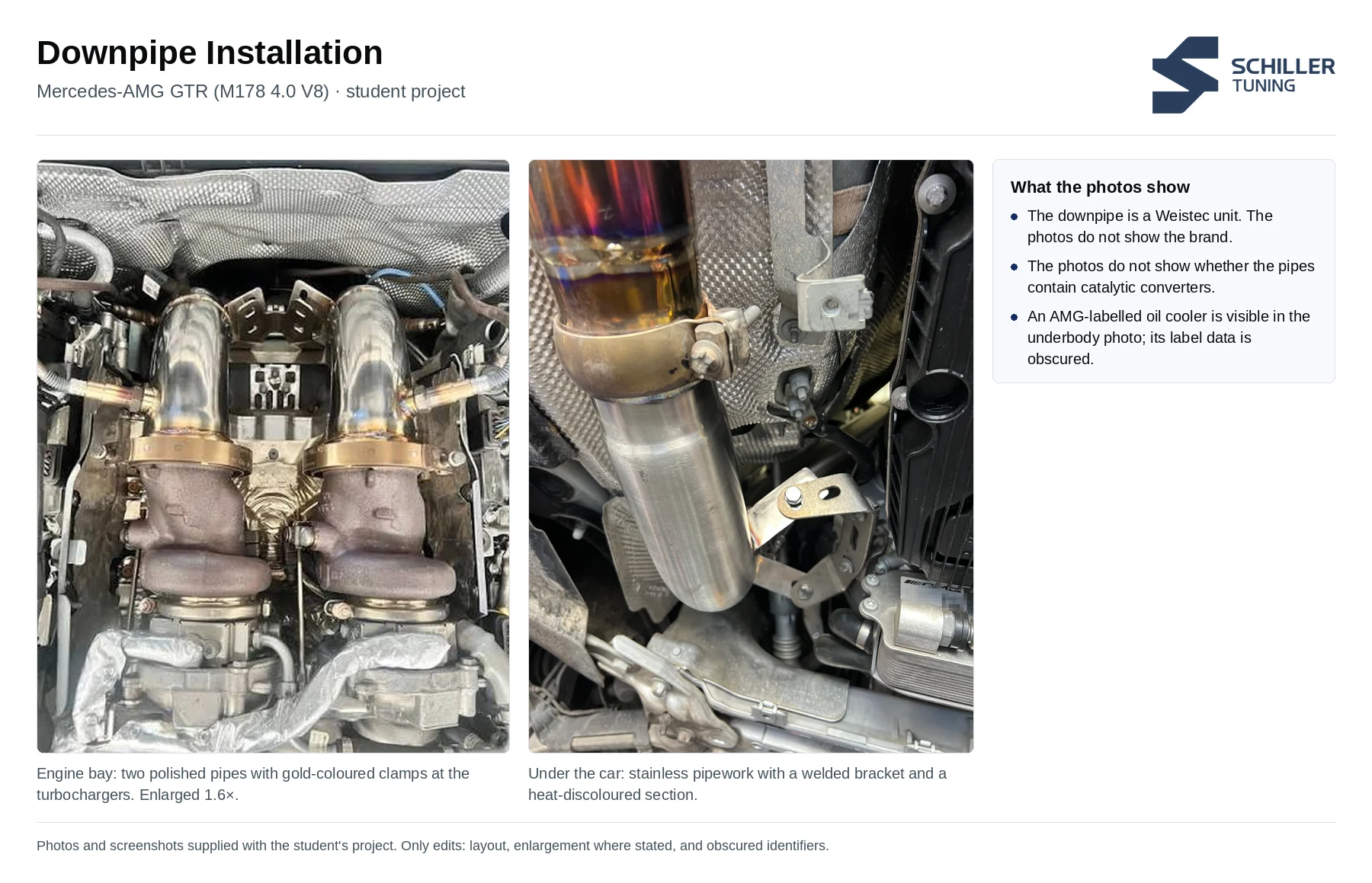
I had no dyno to measure a baseline and a final result, so we agreed the tune had to be extremely safe. We started with a downpipe, because I expected the exhaust gas to leave faster, the turbo and cylinder head temperatures to drop, and the power to improve through better scavenging.
After that, the plan was to work slightly on the torque limiters, to adjust the airflow and intake/turbo maps a little because the engine should breathe more freely with a downpipe, and to build a burble with pops and bangs.
Backing up the ECU before anything else
After the course, Alex advised me to buy a KESS3 Master so I could read files myself and edit them in ECM Titanium. When I selected this ECU, a Bosch MED17.7.5, the compatibility list showed that over OBD I could only do a virtual read (VR).
Because the ECU could not be replaced or recovered, I did not read it that way. Again on Alex’s advice, I used the pinout diagram for this ECU and took a full bench backup of the micro, the flash and the EEPROM. Then I read the ECU file in bench mode and opened it in ECM Titanium. Alientech describes bench mode as a direct connection to the control unit through its connector, which can read the unit’s full content.
Editing the maps with my mentor
I did not have much experience yet, so I asked Alex for help again and we edited the maps together. For the sound, I worked from my training on the base ignition timing, spark advance and minimum spark advance maps, the overrun fuel cut-off maps and the engine-speed lower threshold maps, then adjusted the ignition retard and the unburnt fuel going into the exhaust.
My first version had quite a lot of ignition retard and was very loud. The owner did not want it that loud, so we reduced it.
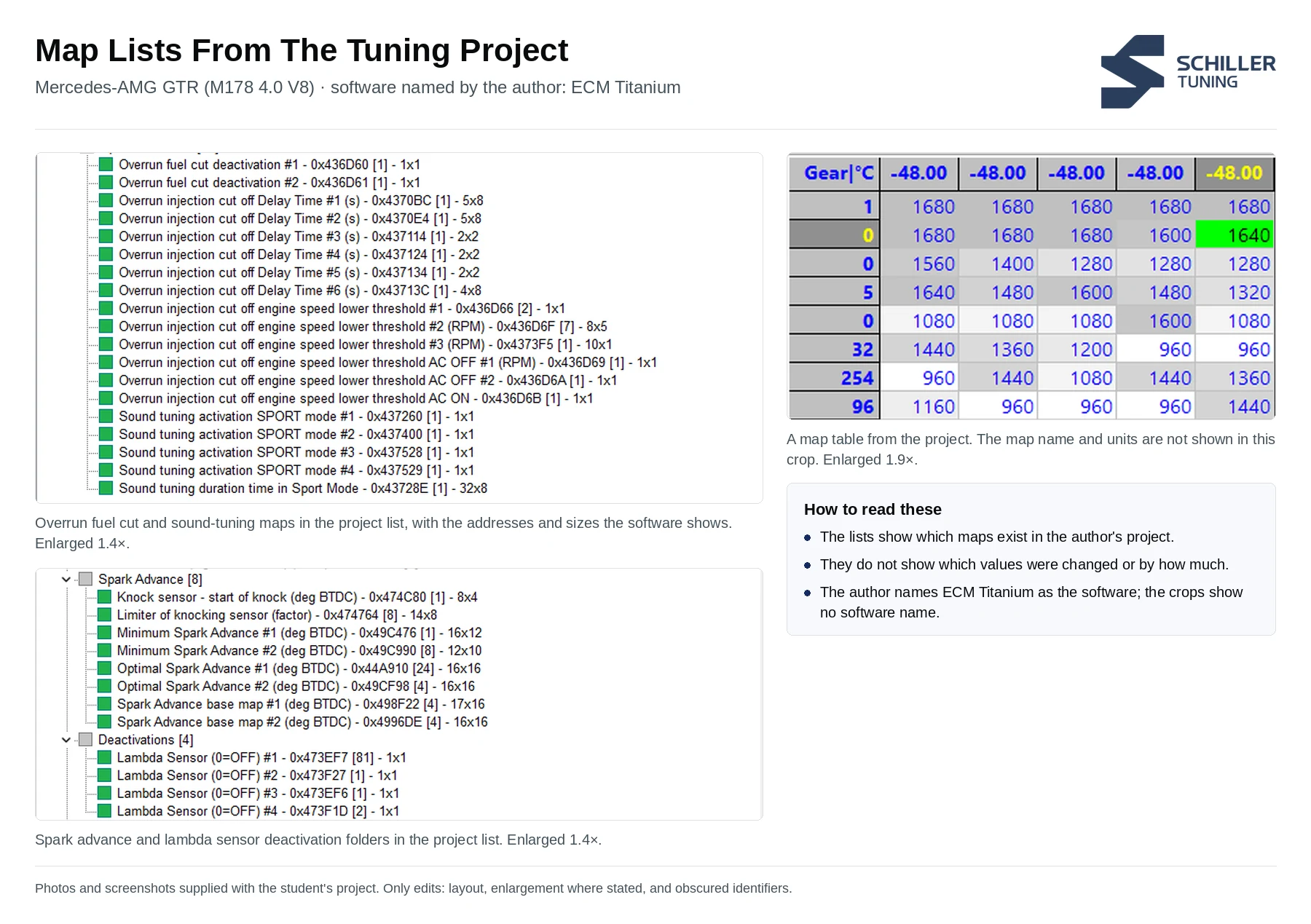
What we changed
Map values depend on the exact ECU software and engine and should not be copied to another car, so this section describes what we worked on rather than listing numbers.
- Torque limiters. We worked slightly on the torque limiter maps, to improve the engine’s limited torque while keeping the tune very safe.
- Airflow and intake/turbo maps. We changed them by about 2% to 5%, because with a downpipe the engine scavenges better and can breathe more freely.
- Ignition timing and retard. We worked on the base ignition timing, spark advance and minimum spark advance maps and adjusted the ignition retard. The first version had a lot of retard and was too loud, so we reduced it.
- Overrun fuel cut-off and unburnt fuel. We adjusted the overrun fuel cut-off maps, the engine-speed lower threshold maps and the amount of unburnt fuel going into the exhaust, to get pops, bangs and a subtle backfire on deceleration.
- Diagnostic code P0420. The check engine light came on with P0420 right after the downpipe was fitted. I removed the code in the ECU, using what I learned in Schiller Tuning’s petrol DTC removal course.
Results: the test drive
Because I had no dyno, we took the car for a test drive. The car’s boost gauge reached its maximum, which to me showed that we had full boost according to the modified turbo maps.
The owner felt that top-end acceleration had improved significantly, and when we let off the gas on deceleration we got pops, bangs and backfire, which he liked.
What these results do and do not show
- There was no dyno, so there is no before-and-after power or torque figure. The acceleration comment is the owner’s impression from one test drive.
- No data logs, boost pressure, air–fuel ratio, temperatures or sound level were supplied. Boost was judged only from the car’s own boost gauge reaching its maximum.
- The safety reasoning describes what we aimed for, not measured proof, and long-term reliability is not known.
- All of this applies to this car and its ECU software. Do not copy the changes to another vehicle. Fitting a downpipe and removing an emissions-related fault code such as P0420 can affect emissions compliance, roadworthiness and warranty, and the rules differ between countries, so check what applies to you.
What I learned
- On an expensive car whose ECU cannot be replaced, take a full backup before you edit anything.
- Check the tool’s compatibility list first. For this Bosch MED17.7.5 only a virtual read was possible over OBD, so I read it on the bench.
- If you do not have much experience yet, ask for help with the map changes.
- Listen to the owner. My first sound setting was too loud for him, so we reduced the ignition retard.
- A downpipe can bring a check engine light with it. In my case it was P0420.
The course and the support behind the project
I wanted to write my own remaps instead of buying file services from tuning companies. I took Schiller Tuning’s petrol remapping course about six months ago, practised for a long time afterwards, and later bought the petrol DTC removal course too.
My mentor Alex advised me to buy the KESS3 Master and to take the bench backup, and he helped me with the map changes when I did not have much experience yet. I learned the process in a structured way, and I recommend Schiller Tuning courses to others.
Want to develop your skills in this area? Explore the ECM Titanium ECU Remapping & Tuning Course (Petrol) to see the full curriculum.
Frequently asked questions
Can the Bosch MED17.7.5 in a Mercedes-AMG GTR be read over OBD with KESS3? In my project the compatibility list offered only a virtual read (VR) over OBD for this ECU, so I read it in bench mode using the pinout diagram, after a full backup of the micro, the flash and the EEPROM. Check the list for your own ECU and software version before you choose a method.
Why did a downpipe bring up P0420? P0420 means catalyst efficiency below threshold on bank 1. In my case the check engine light came on with P0420 right after the downpipe was fitted. Schiller Tuning’s article on catless vs catted downpipes explains the difference between the two types.
Can you tune safely without a dyno? Without a dyno there is no before-and-after figure, so we kept every change small and judged the result on a test drive. A dyno run and data logs are what turn an impression into a measurement; Schiller Tuning’s dyno course covers how dyno graphs are read.