WINOLS Advanced Remapping Course | Bosch ME Series Training ME7,ME9, ME17,MED17
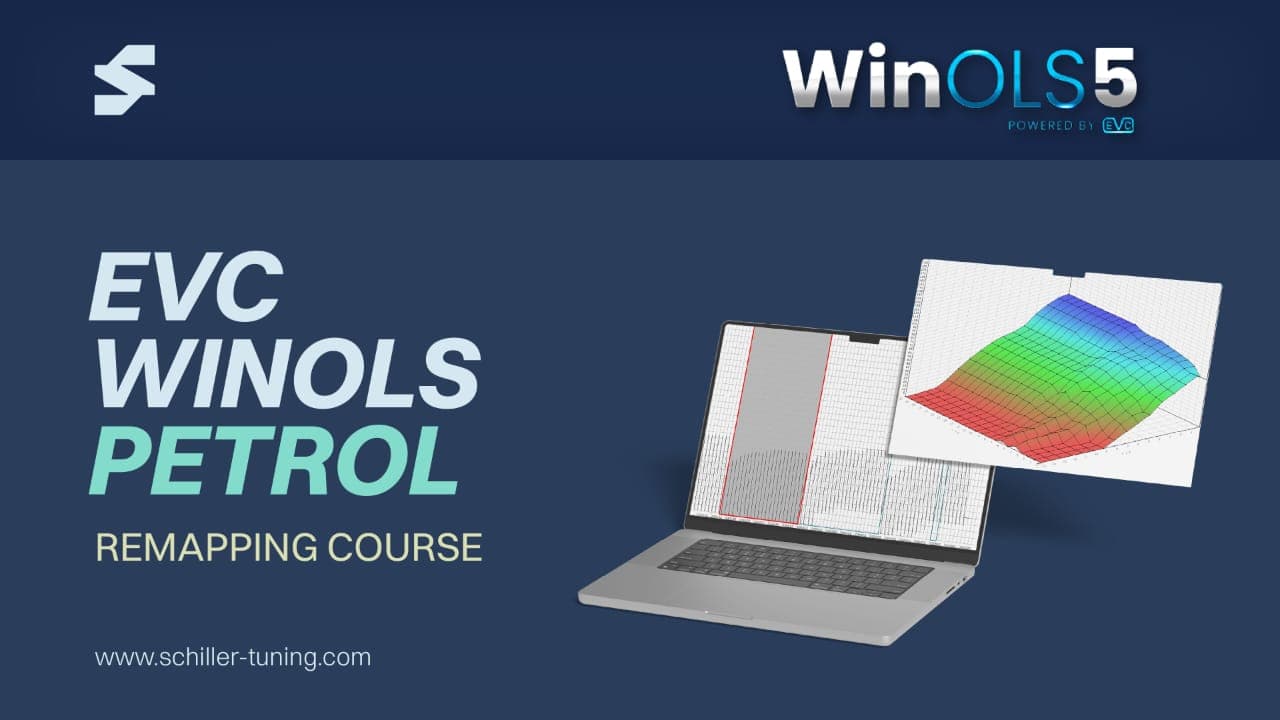
WINOLS petrol professional advanced remapping course for Bosch ME series. Learn ME17, ME7, ME9, MED17 ECU tuning and map analysis.
Lectures Details
Advanced Bosch ME Series ECU Remapping Course – WinOLS Training (Schiller Tuning Academy)
If you are planning to become a professional ECU Mapper and want to work on some of the most widely used gasoline ECUs in the world, this course is specifically for you. In this training course, we focus on advanced remapping of Bosch ME series ECUs, including ME7, ME9, ME17, and MED17, which are the most popular engine control units used in modern petrol cars across the world.
These ECUs are installed on a very wide range of vehicles from German and European cars to American vehicles and even many modern Chinese cars. Because of this, learning how these ECUs work and how to properly tune them will allow you to work on a many number of cars and engines. This is one of the main reasons why Bosch ME Series ECU are very important for any professional tuner.
Advanced Bosch ME Series ECU Remapping Tutorial | WinOLS ME7 -ME9- ME17-MED17 Training
This course is conducted entirely in WinOLS, and it is an advanced training course, not a beginner course. Before purchasing this course, you must have already completed the Schiller Tuning Petrol WinOLS Remapping Course. If you have not Watched that course yet, we strongly recommend that you study carefully it first before continuing with this advanced training, because many of the fundamental concepts of map detection, axis recognition, factor and offset calculation, and basic tuning strategies or mathematics are explained in that course.
In addition to the WinOLS knowledge, you must also be familiar with torque based ECU architecture and ECU functional structure. Modern Bosch ECUs, especially ME17 and MED17, are torque based control systems, and without understanding torque structure function , torque model, load calculation, and ECU functional logic, proper and fine tuning is not possible. If you are not fully comfortable with torque based ECU operation yet, we recommend that you read our technical article about torque based ECU strategies before starting this course.
Why We Chose Bosch ME17 for This Training
In this course, we selected a Bosch ME17 ECU as the main training platform. The reason is very important: ME17 is used in a very wide range of modern turbocharged and naturally aspirated engines, and the ECU structure is very similar across many Bosch ME and MED families. If you fully understand ME17 structure, map logic, torque structure, and control strategies, you will be able to work on almost all Bosch ME series ECUs Even newer models like the Bosch MG1 series.
The goal of this course is not just to change or edit some numbers inside maps. The goal is to teach you how to understand the ECU logic, how to find maps without Damos / A2L or map packs, how to analyze Tables, and how to modify them correctly for Stage 1, Stage 2, Stage 3, or custom tuning projects.
In this course, you will learn:
- How to find maps in WinOLS without map pack
- How to recognize maps from binary patterns and metric
- How to analyze maps in 2D and 3D view
- How to identify map axes
- How to calculate and set factor and offset
- How to convert tables decimal values into real values
- How to analyze MAP function before modifying it
- How to correctly modify maps for custom tuning
- How different maps are related to each other
- How torque model, load model, ignition, lambda, and boost work together
Advanced car Tuning Training Course:
A professional tuner must be able to analyze maps, not just edit them. Anyone can change numbers, but a professional tuner understands what the map does, why it must be changed, how much it should be changed, and what effect that edit will have on engine performance, reliability, durability and safety. This is exactly where the difference between a beginner tuner and a professional tuner becomes clear. Sometimes you don’t need change some of tables.
This course from Schiller Tuning Academy is designed to move you from map editing to real ECU calibration and professional tuning.
This course also includes support from our master tuner, and we guide you step by step through the training process so that you can become a professional tuner, not just someone who copies maps.
Maps and ECU Functions Covered in This Course
Below are the main maps and ECU functions that we analyze, locate, and modify during this training course. Each of these sections represents one episode of the course, and in each episode, we show you how to find the map in potential tables WinOLS, how to analyze it, how to calculate axis and factors, and how to remap it professionally.
1. Lambda Request Map
The Lambda Request map is one of the most important maps in gasoline engine tuning. This map defines the target air-fuel ratio under different engine load and RPM conditions this map known as Lambda base map. Typically, the axes of this map are engine speed (RPM) and engine load or air mass (air cylinder filling), and the values inside the map represent the target lambda value requested by the ECU.
Under part load conditions, the lambda is usually around 1.00 for fuel economy, catalytic convertor efficiency and emissions, but under high load like WOT and boost conditions, the ECU requests richer mixtures such as 0.85–0.78 to control exhaust gas temperature, better torque and prevent knock phenomenon. In this course, we teach you how to Find the Lambda Request map in WinOLS without Damos or Mappack, how to identify its axes, how to convert raw values into real lambda values or AFR using factor and offset, and how to safely modify lambda targets for Stage 1, Stage 2, and Stage 3 tuning or custom remap.
2. Lambda for Component Protection
This map is used for component protection, especially to protect the turbocharger, catalytic converter, exhaust valves, and pistons from excessive exhaust gas and combustion temperature. When EGT increases beyond certain thresholds (based on EGT model or sensor), the ECU enriches the mixture (AFR) to reduce combustion temperature and protect engine components.
It should be noted that ECU use also other strategies such as fuel enrichment, such as boost limiter, torque limit, spark timing adjustment, or VVT adjustment to control EGT, and do not just use a single parameter or table to control this important.
The axes of this map are usually exhaust gas temperature or modeled temperature and engine load or RPM. In this course, we show you how to identify this protection strategy, how to find the related maps in WinOLS, and how to modify them correctly without removing engine safety strategies.
3. Injection Correction Map
Injection correction maps are used to adjust injection time based on various conditions such as battery voltage, fuel pressure, intake air temperature, coolant temperature, and engine load. These corrections apply to ensure that the actual injected fuel mass matches the requested fuel mass, Because in closed loop systems, the fuel amount must be precisely adjusted based on AFR so that the ECU can always make fuel corrections based on feedback.
These maps usually have axes such as battery voltage vs injection time correction (injector MS) or fuel pressure vs correction factor. In this course, we teach you how to find these correction maps, how to understand their function, and when they need to be modified during custom tuning.
4. Ignition Maps –) Base, Optimum, Minimum(
Ignition timing (spark advance map) is one of the most important parameters affecting engine power, efficiency, and knock tendency in petrol engines. Bosch ME ECUs usually use multiple main ignition maps such as Base Ignition Map, Optimum Ignition Map, and Minimum Ignition Map.
These maps typically use engine load and RPM as axes. The ECU calculates final ignition timing based on knock detection, intake air temperature, coolant temperature, and torque model And based on these parameters, the ECU has the option to use the optimum ignition tables or come close to their numbers. In general, it can be said that the numbers in this table are highly variable from basic to optimum map.
In this course, we explain how ignition strategy works, how to locate ignition maps in WinOLS, and how to safely adjust ignition timing for performance without causing knock and incorrect combustion .
5. Knock Control and Knock Detection Maps
Knock control is a critical part of engine safety and performance. Bosch ECUs continuously monitor knock sensors and adjust ignition timing accordingly. There are maps for knock sensitivity, knock retard, knock thresholds, and knock recovery. Wrong edit of this table and if the tuner is not professional, it is like a double-edged sword that can lead to engine failure in a fraction of a second.
In this course, we teach you how knock detection works, how the ECU reacts to knock, how to find knock control maps, and how to modify them carefully for high performance tuning in safe mode without tendency to knock .
6. Air Mass Maps
Air mass calculation is the foundation of torque-based ECUs. The ECU calculates engine load based on air mass entering the engine. Many important maps such as torque model, fuel injection, ignition, and boost control (% wastegate control) depend on air mass calculation.
These maps usually use RPM and throttle angle or boost pressure as axes. In this course, we show you how air mass maps work, how to find them in WinOLS, and how to adjust them when increasing boost pressure or volumetric efficiency for better performance.
7. Engine Load and Nominal Air Maps
Engine load maps define the relationship between air mass, torque request, and engine load calculation. Nominal air maps are used by the ECU to calculate target air mass for a given optimum torque.
These maps are extremely important in torque-based ECUs because many limiters and torque control strategies depend on load calculation. In fact, it can be said that it is based on the amount of engine load that the ECU decides how much optimum torque to produce. In this course, we teach you how to identify load maps, how they interact with torque model, and how to modify them properly for Stage tuning.
8. Torque Limiters and Torque Limitation Maps
Torque limiters are everywhere in Bosch ME ECUs. There are torque limiters based on gear, RPM, temperature, intake air temperature, coolant temperature, engine load, speed, and many other conditions.
If torque limiters are not adjusted correctly, the engine will not produce more power even if boost and fuel are increased. The important thing about this table is that these delimiters are sometimes a table and sometimes just a number or a single parameter. In this course, we show you how to find torque limiter maps, how torque monitoring works, and how to correctly adjust torque limits without triggering torque intervention and torque monitoring error.
9. Turbo and Boost Control Maps
Boost control maps control turbocharger pressure based on torque request, engine speed, EGT, turbo speed, intake temperature and load. These maps include boost target maps, wastegate duty cycle maps, boost limiters, pressure ratio maps and ambient pressure.
We teach you how to identify boost maps, how boost control strategy works in torque-based ECUs, and how to increase boost safely for Stage 1, Stage 2, and Stage 3 tuning.
10. EGT – Exhaust Gas Temperature Maps
EGT maps are used for component protection like catalytic convertor, valves and turbocharger safety. When exhaust gas temperature becomes too high (its depend on engine design and technology), the ECU may enrich mixture, reduce ignition timing, or reduce boost pressure and limit torque to protect engine.
In this course, we teach you how EGT model works, how to find EGT protection maps, and how to modify them safely for performance applications.
11. Torque During Take Off / Driver Wish Map
Driver Wish maps convert accelerator pedal position into torque request. These maps usually have pedal position vs RPM as axes and output torque request or load request.
This map directly affects throttle response and vehicle acceleration feel and drivability. In this course, we teach you how to find Driver Wish maps, how to modify them for better throttle response, and how they interact with torque limiters and load model.
12. VVT / VVTi Maps
Variable Valve Timing maps control intake and exhaust camshaft timing depending on engine load and RPM. Proper cam timing can significantly improve torque, power, fuel economy, and turbo response. also in some technology like BMW by adjusting the cam timing ecu control the warmup and catalytic convertor temperature.
These maps usually use RPM and load as axes and control camshaft angle in degrees. In this course, we teach you how to find VVT maps, how cam timing affects engine performance, and how to optimize cam timing for performance tuning.
Final Words
This course is not just a remapping course. This is a complete professional training program for Bosch ME ECU calibration. By the end of this course, you will be able to:
- Find maps without Damos or A2L
- Analyze ECU maps professionally
- Understand torque-based ECU structure
- Modify maps safely and correctly
- Perform Stage 1, Stage 2, Stage 3, and custom tuning
- Work on many Bosch ME ECUs across different vehicles
This course is designed to transform you from someone who edits maps into someone who understands ECU calibration and becomes a professional tuner.
Schiller Tuning Academy will guide you step by step on this path.

About the course author

Frequently Asked Questions
Quick answers to common questions about our servicesLeave a Comment
Have a question or feedback? Share it with us in the comments.
Secure Payments