
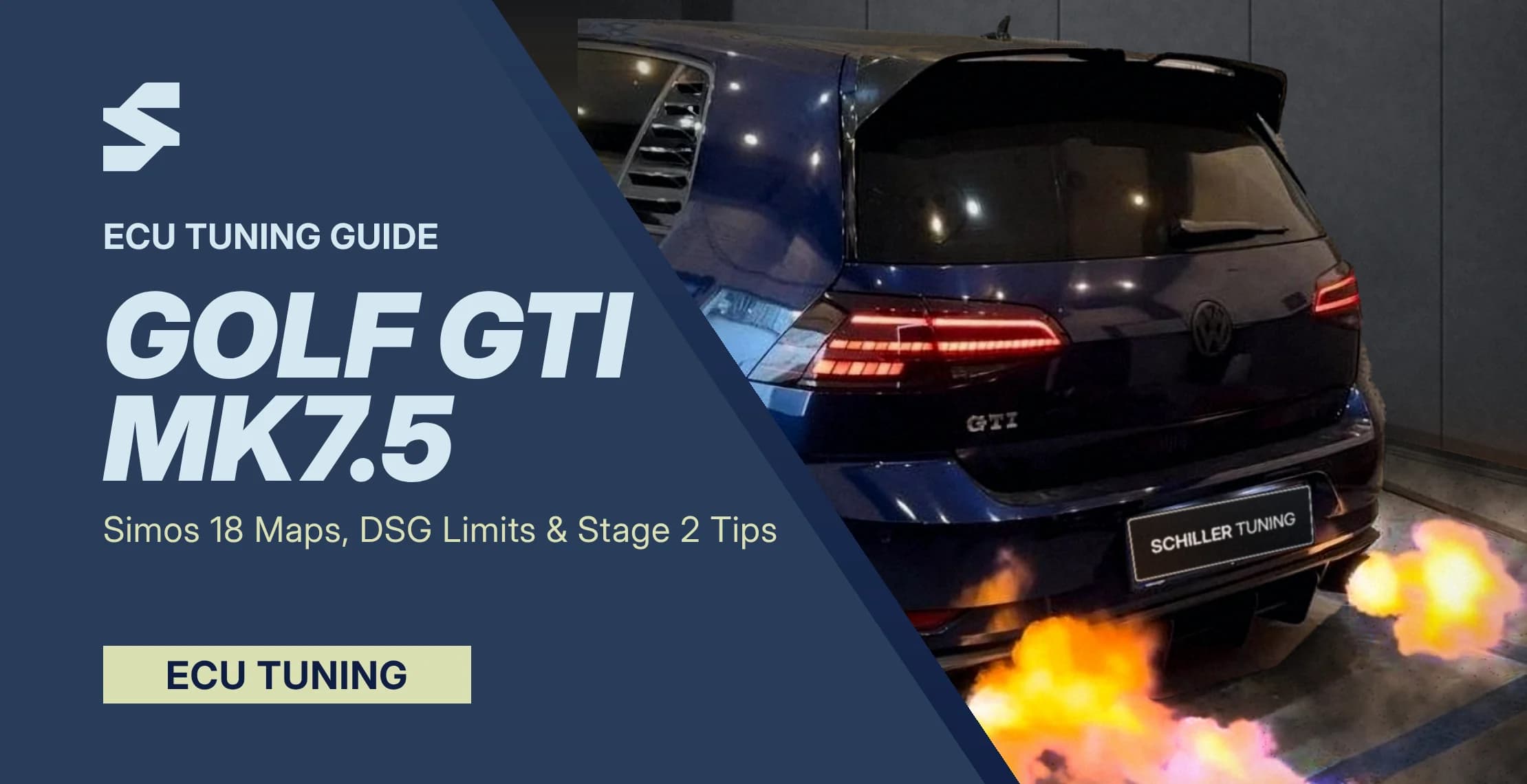
Short answer: A Golf GTI Mk7.5 with a downpipe, intake, exhaust and water-methanol injection made 312.7 PS and 508.8 Nm at the wheels on a Dynojet after calibration by Ben Jalili of Schiller Tuning. On this car the result is set by three limits working together: the torque the Simos 18 engine ECU requests and credits, the torque limit the DSG gearbox accepts, and the knock limit that decides how much ignition timing the engine can use. This guide explains the maps behind each limit, using real values from a stock MQB calibration, and then shows how they played out on the dyno.
Scope: MQB cars with the EA888 Gen 3 2.0 TSI and a wet-clutch DSG (Golf GTI Mk7 and Mk7.5 and related models). We explain how the maps work and what to check; we do not publish map addresses or tuned calibration values, and the map values shown are a stock example from public documentation. The dyno figures belong to one car on one day.
The customer's Golf GTI Mk7.5 on the chassis dyno during the calibration session. Image retouched: dyno room darkened and simplified, number plate covered.
The car and the ECU: Mk7.5 GTI, EA888 Gen 3, Simos 18 and DSG
The Golf Mk7.5 is the 2017 update of the seventh-generation Golf. Volkswagen rated the GTI at 169 kW (230 PS) and the GTI Performance at 180 kW (245 PS), and introduced a 7-speed DSG that gradually replaced the 6-speed DSG [4]. Rated torque is 350 Nm for the GTI and 370 Nm for the GTI Performance [16][17].
| Item | Specification | Source |
|---|---|---|
| Engine family | EA888 third generation, 2.0 TSI, four cylinders, turbocharged | [3] |
| Bore × stroke | 82.5 mm × 92.8 mm, about 1,984 cm³ | [3] |
| Compression ratio | 9.6 : 1 (2.0 TFSI in the training manual) | [3] |
| Exhaust manifold | Integrated into the cylinder head, water-cooled | [3] |
| Wastegate | Electric actuator with position sensor | [3] |
| Injection | Direct injection up to 200 bar; port injection added in some markets | [3] |
| Knock control | Cylinder-selective | [3] |
| Engine ECU | Continental Simos 18 family | [9][15] |
| Gearbox | 6-speed DQ250 or 7-speed DQ381 wet-clutch DSG, by version and build date | [4][10][11] |
| Factory rating | 230 PS / 350 Nm (GTI) or 245 PS / 370 Nm (GTI Performance) | [4][16][17] |
One common mistake: this is not a Bosch ECU. MQB cars with the EA888 Gen 3 use the Continental Simos 18 family [9][15]. The control idea is still the same torque-based logic that Bosch published for ME7 [1], which is why we use Bosch's model as a reference below.
How a Simos 18 ECU turns the pedal into torque
The ECU does not think in "boost" or "timing" first. It thinks in torque. The pedal position becomes a driver torque request, and the ECU then works out how to deliver it through two paths [9]:
- Slow path (air): the air-mass set point, the throttle, the turbocharger actuator and the camshafts. These take time to respond.
- Fast path (combustion): ignition timing, fuel and lambda, and fuel cut-off. These act within the next combustion events.
Bosch described the same split for ME7 as long-term and short-term torque demands [1]. On the MQB 2.0T, tuning documentation describes the slow path as a chain: the maximum-torque tables set what the driver may request, an air-mass set point table converts that torque into air per stroke, and a pressure-before-throttle set point turns that air into a boost target for the electric wastegate [6]. The engine has no air-flow meter here; the ECU infers air mass from a pressure sensor in the intake manifold [6].
How the MQB engine ECU credits torque to the ignition timing it can actually use, step by step beside Bosch's published torque model [1][5].
The map families that matter on a Mk7.5 GTI
Names differ between tools and software versions, so the table below uses plain descriptions. What matters is what each group decides.
| Map group | What it decides | Tuning note |
|---|---|---|
| Maximum torque (manual / automatic) | The highest torque the driver can request at each engine speed | Raising it alone does nothing if the air and boost limits below stay stock [6] |
| Air-mass set point for torque | How much air per stroke is needed for a requested torque | Acts as a ceiling for boost; check it first if boost does not respond [6] |
| Pressure-before-throttle (boost) set point | The boost target that delivers the air-mass set point | Keep its axes consistent with the air-mass tables [6] |
| Turbocharger speed limit | Protects the turbo from overspeed | Must be raised with boost, or faults appear [6] |
| Wastegate actuator end positions | The working range of the electric wastegate | Electronic actuator, no boost solenoid [3][6] |
| Lambda targets | Air-fuel ratio by air flow, full load and intake temperature | Closed loop on a wideband sensor; targets are what the ECU aims for [6] |
| Component-protection lambda | Enrichment to protect the catalyst and turbo from heat | Separate from the main targets; check both [6] |
| Injection scaling | Converts the fuel-mass set point into injection time | On 2017-on GTI software, the fuel-mass set point needs rescaling as injection times approach about 6.5 ms [6] |
| Ignition: base, minimum, reference | The timing used, the lowest allowed, and the best-case benchmark | Base and reference work as a pair; see the next section [5] |
| Ignition corrections | Changes for charge-air or intake temperature and for combustion mode | Charge-air temperature has a large effect on this engine [6] |
| Knock control | Per-cylinder retard when knock is detected | Steps of about 0.38°; log all four cylinders [6] |
| Intake (tumble) flaps | Flap position for charge motion or full air flow | Ignition and torque tables exist per flap position [5][6] |
Ignition maps explained with real values
The MQB engine ECU holds three sets of ignition tables: base, minimum and reference [5]. The base set is the timing the engine actually gets, before corrections. The reference set is a benchmark: the best timing under ideal conditions, with no octane limit [5]. The distance between the two tells the ECU how much torque it is giving up.
The charts below use the base and reference tables of a stock MQB calibration, published in public tuning documentation [5]. Both are indexed by engine speed and air mass per stroke, which is the engine's load axis. The source does not name the vehicle or the software version, so treat the numbers as a worked example, not as values for your car.
Base and reference ignition timing at 1,500, 3,000 and 5,000 rpm. The shaded gap is the timing the ECU gives up compared with the best case.
Three things stand out:
- At light load the two tables agree. Below about 300 mg per stroke both hold the same fixed value, 40.13°. The difference is zero, so no torque is deducted there.
- At low engine speed and high air mass the gap is large. At 1,500 rpm and 1,500 mg per stroke the reference set asks for 10.5° before top dead centre, while the base set gives −9.0°, which is 9° after top dead centre. That is 19.5° of retard: the engine is knock-limited.
- At high engine speed the gap closes. At 5,000 rpm the retard at the same air mass is 11.2°, and at medium load only 1–4°. Faster combustion events leave less time for knock to develop.
Reference minus base timing across the whole map. The dark area at low engine speed and high air mass is where better fuel, lower charge temperature or water-methanol pays off most.
Some cells at very low engine speed and very high air mass are hard to reach with the factory turbocharger. They still matter, because the ECU interpolates between neighbouring cells.
From timing to torque: the efficiency table and reference torque
Here is how the ECU turns the timing gap into a torque number [5]:
- Calculate the final base timing and the final reference timing, each after its own corrections.
- Subtract base from reference. Volkswagen description files call this difference IGA_DIF.
- Look up the difference in an ignition efficiency table.
- Multiply the efficiency by a value from the reference indicated torque map. The result is the reference torque set point.
The ignition efficiency table from the same stock calibration. Retard of 6.4° costs 2 % of torque; 20.3° costs 13 %; 29.3° costs 29 %.
Engineer's check. Is 0.36 Nm per mg per stroke believable? One milligram of air per stroke at λ = 1 carries 1 ÷ 14.7 ≈ 0.068 mg of petrol, or about 2.9 J of fuel energy at 43 MJ/kg. Four cylinders fire once every two revolutions, so 4 × 2.9 J ÷ 4π ≈ 0.93 Nm per mg would be the torque at 100 % efficiency. The map's 0.36 Nm per mg therefore means about 39 % indicated efficiency, which is a realistic figure for a modern direct-injection petrol engine at its best timing. The units are consistent.
This is Bosch's torque model in different clothes. In the ME7 paper, inner torque equals the optimum torque for the current charge and speed, multiplied by efficiency factors, one of which depends on the distance between actual and optimum spark advance [1]. VW's reference timing plays the role of the optimum spark, IGA_DIF plays the role of that distance, and the reference indicated torque map plays the role of the optimum-torque map.
Worked example with the stock tables
| Engine speed | Air mass per stroke | Reference timing | Base timing | Retard | Efficiency | Reference indicated torque | Torque credited |
|---|---|---|---|---|---|---|---|
| 2,000 rpm | 900 mg | 14.6° | −1.1° | 15.8° | 0.92 | 327 Nm | 302 Nm |
| 3,000 rpm | 750 mg | 19.1° | 12.0° | 7.1° | 0.98 | 282 Nm | 276 Nm |
| 5,000 rpm | 1,050 mg | 19.9° | 16.5° | 3.4° | 0.99 | 391 Nm | 387 Nm |
Values are interpolated from the stock tables [5]; torque is indicated torque, before friction and pumping losses, and before the other correction factors the ECU applies. The example shows the principle: at 2,000 rpm and 900 mg per stroke, the stock calibration gives up 15.8° of timing and credits only 92 % of the reference torque. If knock margin allowed the gap to close to 5°, the efficiency would rise to about 0.98 and the same air would make roughly 7 % more torque.
Why this matters on a tuned car
- The DSG believes this number. The torque the engine ECU calculates is the engine torque the DSG controller reads [8]. The purpose of the reference calculation is to make that number match what the engine really makes [5].
- Edit base and reference as a pair. The same documentation warns that the system can cause problems when the calibration values differ by a large amount [5].
- Watch the end of the efficiency table. In this calibration the table ends at 0° with an efficiency of 1.00. If base timing is set above reference, the lookup cannot go higher than 1.00, so the ECU credits no extra torque for that timing. The engine may then make more torque than it reports, and the gearbox sets its clutches for less torque than they carry.
Fuel and lambda targets
The 2.0T runs direct injection and stays in closed loop on its wideband oxygen sensor; the values in the lambda tables are targets, and the ECU trims fuel to reach them [6]. Two groups matter:
- Main lambda targets by air flow, at full load and at high intake temperature [6].
- Component-protection targets that enrich the mixture to keep the catalyst and turbocharger temperatures in check [6].
Richer is not automatically safer. Extra fuel cools, but it also costs power, and at very rich mixtures combustion slows. Leaner mixtures make more power and more heat, and on lower-octane fuel they bring the knock limit closer [6]. Fuel and ignition have to be tuned together.
On fuel delivery, public documentation notes that later GTI software converts the fuel-mass set point into an effective injection time, and that the set point table needs rescaling once injection times approach about 6.5 ms [6]. On a Stage 2 car with water-methanol, log injection time and rail pressure against their targets at full load before adding more air.
Boost and the air path with a downpipe and intake
On this engine the boost target follows from the torque request: maximum torque → air-mass set point → pressure-before-throttle set point → wastegate position, with a turbocharger speed limit on top [6]. The EA888 Gen 3 positions its wastegate with an electric actuator that has its own position sensor [3], so the ECU knows where the wastegate is, not only where it asked it to be.
- Downpipe and exhaust. Lower pressure after the turbine means the turbine needs less pressure before it to do the same work. The ECU reaches its boost target with the wastegate further open, and exhaust back-pressure on the engine falls.
- Intake. A lower pressure drop before the compressor reduces the work the compressor must do for the same boost. Because the ECU calculates air from manifold pressure rather than a flow meter, an intake change does not require air-flow sensor rescaling [6].
- Neither part adds power by itself. Each moves the point where the air path runs out of margin. The calibration then has to raise the air-mass ceilings, the boost set point and the turbo-speed limit together [6].
Respect the turbocharger. Tuning documentation for these cars warns that the factory turbo can be pushed beyond about 29 psi (2 bar) of boost in the mid-range, which is enough to damage the engine [6].
The DSG decides how much torque the engine may make
On an MQB DSG car the gearbox controller is part of the torque structure. It does not just shift gears; it tells the engine how much torque it will accept.
Engine and gearbox limits on an MQB DSG car. The lowest active limit wins, and the DSG sets clutch torque from the torque the engine reports.
- Engine side. The ECU holds a maximum engine torque, a maximum clutch torque and an engine-speed limit, and it records which function is limiting torque at any moment [7].
- Gearbox side. The DQ381 controller holds a maximum torque for gearbox protection and sends it to the engine ECU [10]. There are also separate maximum-torque tables for each clutch [12].
- Clutch pressure. To hold more torque, the clutch and line pressure limits usually have to rise as well; one vendor's ready-made DQ381 maps raise the maximum clutch pressure from 15 bar to 21 bar [12].
The DQ381 has been used with the 2.0 TSI in MQB cars since 2017 and is commonly quoted at 420 Nm input torque [11]. In stock form some calibrations limit torque to around 370–400 Nm [10]. This car measured 508.8 Nm at the wheels, calculated on an engine-speed basis. Driveline losses come after the clutch, so the clutch carried at least the measured torque; because the screen does not show whether a weather correction was applied, read that as about 500 Nm or more. That is well above both figures, which makes clutch condition, clutch temperature and an accurate engine torque signal part of the calibration, not an afterthought. Our TCU tuning and gearbox remapping course covers the gearbox side in depth.
Water-methanol injection and the knock limit
Bosch developed water injection for production engines and first supplied it for the BMW M4 GTS [13]. At high load many petrol engines inject extra fuel that does not burn usefully; it evaporates to cool the engine and turbocharger. Water does that job better because of its high heat of vaporisation. The charge runs cooler, knock is reduced and earlier ignition becomes possible [13]. Bosch engineers also described how water injection can reduce or avoid fuel enrichment at high load [14]. In aftermarket systems the water is usually mixed with methanol, which also works as antifreeze [14].
In map terms, look back at the retard heat map. Water-methanol lets base timing move closer to reference before knock control steps in. The retard shrinks, the efficiency rises, and the same air makes more torque. Alternatively the calibration can keep the timing and use the margin for more air. Three points need care:
- Methanol is a fuel. Because the ECU runs closed loop [6], it sees the extra fuel and trims petrol back. Log fuel trims with the system on and off; large full-load trims mean the fuel model and the injected methanol are not matched.
- The tank can run dry. Bosch's production engine keeps running normally without water, only without the extra torque [13], because the factory calibration is designed for it. An aftermarket calibration that uses the extra knock margin needs its own fallback: flow monitoring and a safe map or torque limit when flow stops.
- Distribution is never perfect. A nozzle in the intake does not feed every cylinder equally. Per-cylinder knock retard [7] shows whether one cylinder is getting less cooling than the others.
For more on how knock limits a calibration, read our article on the causes of engine knock and how ECU remapping deals with them. Exhaust temperature, the other limit that water-methanol moves, is covered in our guide to EGT in ECU tuning.
What to log on an MQB car
A dyno sheet shows the result; logs show why. Names differ between logging tools, and not every signal exists on every software. Public monitor lists for MQB cars show which ones are typically available [7][8].
| Question | Engine signals | DSG signals |
|---|---|---|
| Is a limit cutting torque? | Driver requested torque, actual torque, maximum engine torque, maximum clutch torque, torque-limitation source | Maximum torque for gearbox protection, torque reduction during shifts |
| Does the air path keep up? | Air mass per stroke and its set point, boost and its set point, wastegate position, turbo speed and its limit | — |
| Is the engine knock-limited? | Final ignition timing, knock retard per cylinder, ignition efficiency | — |
| Is the mixture right? | Lambda and lambda target, fuel trims, rail pressure and its target, injection time | — |
| Are temperatures under control? | Charge-air temperature, intake temperature, coolant and oil temperature | Gearbox oil temperature |
| Is the clutch coping? | Engine torque and its rate of change | Clutch slip and clutch pressure for each clutch |
Two practical warnings from public tuning documentation: the coolant gauge on the dashboard is an inferred value, so log the actual coolant temperature, and switch off lane-keeping assist before a dyno run [6]. Our ECU datalogging training teaches how to read these logs on real cars.
Case study: Golf GTI Mk7.5 on the dyno
At a glance
| Item | Detail |
|---|---|
| Vehicle | VW Golf GTI Mk7.5, wet-clutch DSG, about 57,000 km |
| Engine and ECU | EA888 Gen 3 2.0 TSI, Continental Simos 18 family |
| Hardware | Downpipe, exhaust, intake, water-methanol injection |
| Read and write | Autotuner |
| Calibration | Ben Jalili, Schiller Tuning |
| Measurement | Dynojet chassis dynamometer, WinPEP 8; figures from the final run |
| Outside temperature | 27 °C, as shown on the instrument cluster |
Results
| Measurement at the wheels | Value |
|---|---|
| Peak power | 312.69 PS at 5,120 rpm (230.0 kW, about 308 hp) |
| Peak torque | 508.77 Nm at 3,270 rpm (about 375 lb-ft) |
| At 5,694 rpm (cursor point) | 301.46 PS and 371.85 Nm |
Final run, re-drawn from the dyno screen: 508.8 Nm at 3,270 rpm and 312.7 PS at 5,120 rpm at the wheels.
The original Dynojet WinPEP 8 screen for the same run, straightened and cropped from a photo. Values unchanged.
How to read these figures:
- Wheel figures. Measured on a chassis dynamometer, so driveline losses are already subtracted. They cannot be compared directly with factory ratings, which are measured at the crankshaft.
- Power unit. The screen does not print the unit. The values satisfy P = T × n ÷ 7023, the relation for power in PS with torque in Nm and speed in rpm: 371.85 × 5,694 ÷ 7023 = 301.5 PS, as displayed. The owner's "312 whp" is therefore 312.7 metric horsepower at the wheels.
- Torque basis. The torque is wheel power divided by engine speed, not the torque at the wheel hub.
- No gain is claimed. There is no stock run of this car on the same dyno, so we do not state a before-and-after difference.
What the curves show
- Torque arrives early. The torque line climbs steeply to its peak at 3,270 rpm and stays above 480 Nm until about 4,000 rpm. That plateau is where the torque request, the air-path limits and the gearbox limit meet.
- Torque then falls steadily to 371.9 Nm at 5,694 rpm, while power peaks at 5,120 rpm. With the factory turbocharger, falling torque at high engine speed is consistent with an air path near its flow limit. Boost and turbo-speed logs would confirm it.
- The gearbox carried well above its usual rating. That is why the DSG side is part of this build.
Calibrator's notes: Ben Jalili
"Before I touch the engine side of a DSG car, I check what torque the gearbox controller will accept. If the engine asks for more than that, the gearbox limit wins and the car feels flat exactly where the torque should be."
"I calibrate base and reference ignition as a pair. If only base timing moves, the torque the engine reports drifts away from what it really makes, and the gearbox is the first part to notice."
"With water-methanol, I start from the empty tank. The car has to be safe with the system off before I use the extra knock margin with it on."
"I don't chase timing that doesn't add torque. If two more degrees don't show up on the dyno, they only add stress."
"I never judge a flash on the first pull. Adaptations reset after programming, so I let the car settle and compare pulls at similar intake temperatures."
"I judge a calibration by its logs, not by its peak number: requested against actual torque, knock retard on every cylinder, and clutch slip at peak torque."
Limits of this test
- One car, one dyno, one final run. No baseline run, correction standard or weather data are shown on the screen.
- The logs behind the calibration are not published with this article.
- Another Mk7.5 GTI with different hardware, fuel or gearbox software can respond very differently.
The car was read and written with Autotuner.
Safety, legality and durability
- Downpipe. A downpipe without a catalytic converter removes an emissions-control device. That is not legal for road use in many countries, and on such cars the calibration is for off-road and motorsport use only.
- Overrun flames. They come from fuel burning in the exhaust, add heat to the exhaust system, add nothing to power, and may break noise or emissions rules where the car is driven.
- Torque monitoring. The standardised E-Gas monitoring concept, written by the German manufacturers, uses a separate monitoring layer that checks calculated torque against permissible torque [2]. We do not disable or bypass it; keeping requested, credited and monitored torque consistent is part of the calibration.
- Gearbox and engine durability. About 500 Nm or more through a DSG rated well below that by common sources [10][11] means shorter margins. Tuning documentation for these cars also warns of early clutch wear above roughly 390 lb-ft, about 530 Nm [6]. Clutch condition, gearbox oil service and logged clutch slip decide how long it lasts.
- Water-methanol failure. A calibration that relies on the extra knock margin needs a working fallback for an empty tank, a blocked nozzle or a failed pump.
- Rules differ by country. Check what applies where the car is used, and have changes of this size reviewed by a qualified calibrator.
Conclusion
A Mk7.5 GTI tune is not one boost map. The Simos 18 ECU turns the pedal into a torque request, credits torque according to how close base timing is to reference timing, and lets the DSG cap the result. This Golf reached 312.7 PS and 508.8 Nm at the wheels because all three moved together: the downpipe, intake and exhaust gave the air path more margin, water-methanol moved the knock limit, and the gearbox side was set to accept far more torque than stock. Change only one, and one of the other two becomes the limit. Before comparing numbers like these between cars, read why dyno-tested and street-tested tuning produce different kinds of evidence, and how a Stage 2 calibration differs from Stage 1. For the same torque logic on a Bosch ECU, see our Bosch ME17 and MED17 tuning guide.
Tune MQB petrol engines with confidence. Learn fuel, ignition, boost and knock calibration on real petrol engines in our WinOLS Petrol Tuning course, or order your tuning file. Engineer review and a 30-day warranty are included in every file.
References
- J. Gerhardt, H. Hönninger and H. Bischof, "A New Approach to Functional and Software Structure for Engine Management Systems – BOSCH ME7," SAE Technical Paper 980801, 1998. doi:10.4271/980801
- EGAS Workgroup, "Standardized E-Gas Monitoring Concept for Gasoline and Diesel Engine Control Units," Version 6.0, 13 July 2015.
- Audi of America, "The Audi 1.8L and 2.0L Third Generation EA888 Engines," eSelf-Study Program 920243, 2013. https://static.nhtsa.gov/odi/tsbs/2014/MC-10122162-9999.pdf
- Volkswagen, "Golf update" press release, as published by Automotive World. https://www.automotiveworld.com/news-releases/golf-update
- COBB Tuning, "VW Reference Torque Set Point Calculations," 11 December 2018. https://cobbtuning.atlassian.net/wiki/spaces/PRS/pages/725221419/VW+Reference+Torque+Set+Point+Calculations
- COBB Tuning, "Volkswagen MQB Tuning Guide," 26 May 2020. https://cobbtuning.atlassian.net/wiki/spaces/PRS/pages/143753246/Volkswagen+MQB+Tuning+Guide
- COBB Tuning, "Engine Monitor List for Volkswagen/Audi MQB Vehicles." https://cobbtuning.atlassian.net/wiki/spaces/PRS/pages/222691360/Engine+Monitor+List+for+Volkswagen+Audi+MQB+Vehicles
- COBB Tuning, "DSG Monitor List for Volkswagen MQB Vehicles." https://cobbtuning.atlassian.net/wiki/spaces/PRS/pages/619970640/DSG+Monitor+List+for+Volkswagen+MQB+Vehicles
- EcuTek, "VW AG EA888 Engine Tuning (Mk7)." https://ecutek.atlassian.net/wiki/spaces/SUPPORT/pages/21430325
- EcuTek, "VW AG DQ381 Transmission tuning." https://ecutek.atlassian.net/wiki/spaces/SUPPORT/pages/1702953321/VW+AG+DQ381+Transmission+tuning
- Actronics, "The evolution of the DSG gearbox." https://www.actronics.co.uk/news/the-evolution-of-the-dsg-gearbox
- COBB Tuning, "Volkswagen MQB 7 Speed DSG Tuning Guide," 2 June 2020. https://cobbtuning.atlassian.net/wiki/spaces/PRS/pages/1052606501/Volkswagen+MQB+7+Speed+DSG+Tuning+Guide
- Robert Bosch, "Water instead of gasoline: Bosch water injection innovation reduces fuel consumption by up to 13 percent," press release. https://www.bosch-presse.de/pressportal/us/en/press-release-695.html
- Mobility Engineering Technology (SAE International), "Bosch Developing New Water-Injection System for Production Engines." https://www.mobilityengineeringtech.com/component/content/article/42141
- AutoTuner, "Continental Simos18.x." https://www.autotuner.com/blogs/news/bosch-simos18-x
- Volkswagen UK, Golf GTI Performance 245 PS and 370 Nm announcement, as published by Conceptcarz. https://www.conceptcarz.com/a21376/view/a53815/info/concept-cars.aspx
- Cars.co.za, "Volkswagen Golf 7 GTI & GTD (2017) First Drive." https://www.cars.co.za/motoring_news/volkswagen-golf-7-gti--gtd-2017-first-drive/43060/
All online sources accessed 3–4 November 2026. Project data: Schiller Tuning, VW Golf GTI Mk7.5, Dynojet chassis dynamometer with WinPEP 8.

About the author
