
Author:
Schiller Tuning Research Team
By The Schiller Tuning Engineering Team This technical review is curated by our Lead Calibration Engineers, specializing in Bosch ME17/MED17/MG1US architectures. With over 14 years of dyno-validated experience in advanced ECU calibration and TCU optimization, our team defines the engineering standards utilized by Schiller Tuning representatives worldwide.
How Remote ECU Remapping Works: Devices, Safety & Process | Shiller Tuning
In today’s digital automotive world, ECU Remapping no longer requires visiting a local tuner or workshop ( you can do it at your home). If you are a vehicle owner who wants professional tuning results but prefers not to deal with local garages, travel, or physical ECU removal, Remote Tuning is the perfect solution.
At Shiller Tuning, we offer a simple, safe, and professional remote Remapping service that allows you to remap your vehicle from home using dedicated end user devices. In this article, we explain how remote tuning works, which devices you can use, the types of tuning available, and how these tools compare. follow these steps and remap your car at home. we will support you.
What Is Remote Tuning?
Remote tuning is a process where your vehicle’s ECU software is read at home via special tool, sent digitally to a professional tuning company or tuner, modified by expert tuner, and then written back to your car all without visiting a workshop.
Instead of bringing your car to a tuner, the tuning comes to you.
This method is ideal for:
• Users who don’t want to visit local tuners or workshops
• Owners who live far from professional tuning centers
• Customers who want convenience and flexibility
• Drivers who prefer working directly with a trusted tuning company like Schiller Tuning
Remote Tuning with Shiller Tuning: How It Works and guide step to step
If you want to use Shiller Tuning’s remote services, the process is straightforward and user friendly. read all steps carefully and if you have any question and support, feel free to ask us.
Step 1: Choose an End User Tuning Device ( ECU Flasher)
To get started, you need one of the dedicated personal ECU flashers designed specifically for end users. These devices are actually connected to your car's diagnostic port, also known as OBD2, and allow you to reprogram the Engine Control Unit (ECU or EMS) through them.
The most popular and reliable options include:
• AutoTuner One
• Dimsport MyGenius
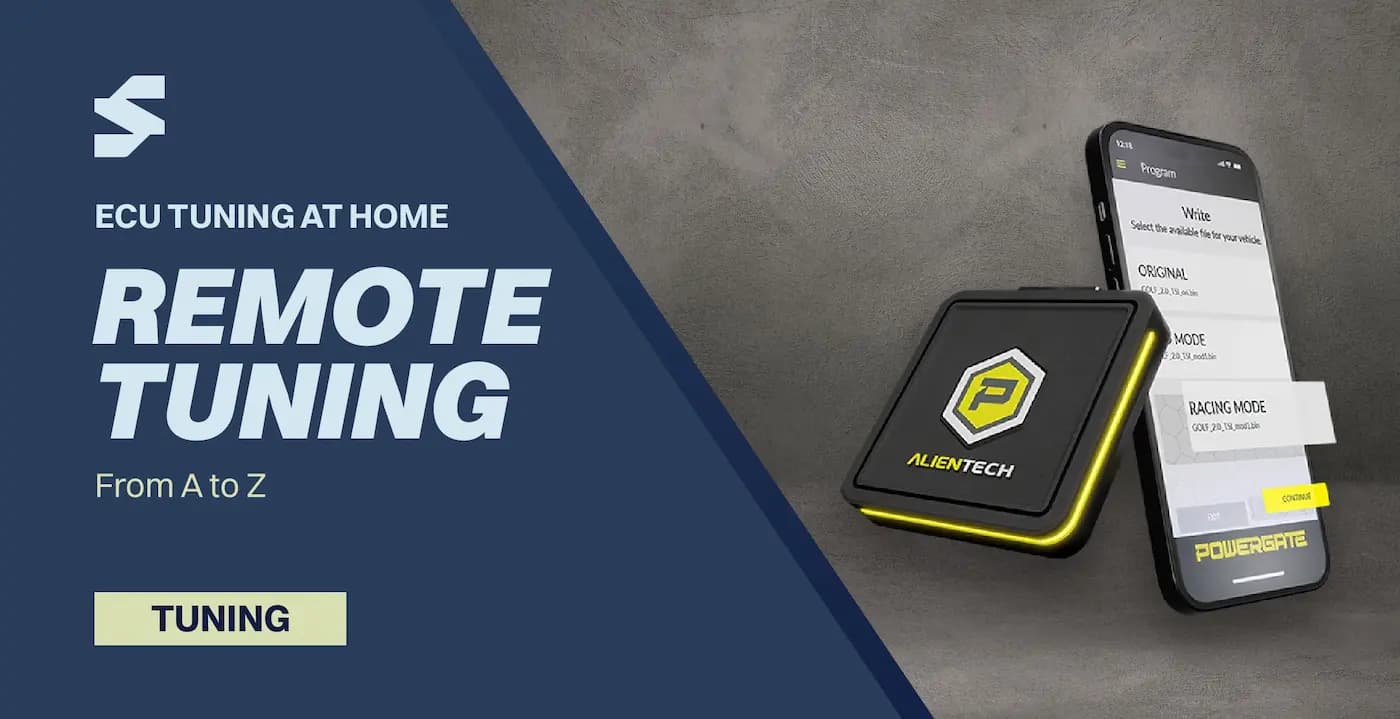
• Alientech Powergate
• HP Tuners
These devices are built to be safe, simple, and VIN-locked, meaning they are tied to your specific vehicle.
In fact, a wide variety of ECU flashers from numerous brands are available on the market today. However, our goal here is to introduce you to the best and most renowned options among them those that are not only user friendly but also safe and backed by robust technical support. Remember that ECU Flasher must be reliable and safe.
Step 2: Read Your ECU at Home
Once you receive the device:
1. Plug device into your car’s OBD-II port (Diag port)
2. Follow the on screen instructions and do everything step to step
3. Read the original ECU file (stock file)
No technical knowledge is required.
No ECU removal and case opening.
No wiring, bench mode, or boot mode.
The device safely extracts your ECU software.
Step 3: Send the File to Shiller Tuning
After reading your ECU, you simply send the file to us.
Our calibration team will:
• Analyze your ECU and engine Data
• Apply safe and optimized tuning on MAPs and parameters
• Customize the file based on your vehicle and condition like quality of fuel that you use
• Test logic, limits, and safety parameters
You receive a professionally developed custom tuning file, not a generic map.
Step 4: Write the Tuned File Back
When your tuned file is ready, we send it back to you.
Using the same device:
• Connect it to the OBD port
• Select “Write ECU”
• Flash the tuned file
The process takes only a few minutes, and you can always restore the original file if needed.
Types of Maps Available with Schiller Remote ECU Tuning
With Shiller Tuning’s remote service, you can choose from different tuning options depending on your goals.
Stage 1 Performance Tune
• Increased horsepower and torque
• Improved throttle response
• Optimized turbo boost and fueling
• No hardware modifications required
This stage is very safe and you can use your car daily
Eco / Economy Tune
• Improved fuel efficiency
• Smoother power delivery
• Optimized torque curves
Specialized Solutions (Where Legally Allowed)
• DPF off
• EGR off
• SCR/AdBlue solutions
• Speed limiter removal
(Note: Emissions-related modifications are for off-road or motorsport use only and must comply with local regulations.)
Custom Tuning (Stage 2 & Stage 3)
• setup map to your driving style
• Adapted for mild hardware upgrades like Decat (Downpipe) or cold intake…
• Balanced performance and reliability acording to your aftermarket parts
Furthermore, we offer a special feature for vehicles that require dyno tuning or custom ecu remapping. This feature enables you to remotely send ECU files and technical data such as data logs or dyno graphs to Shiller Tuning's experts. Based on this precise data, a custom engine map is meticulously and securely prepared for you.
Choosing Your ECU Flasher: A Simple Comparison Guide + Expert Support
To help you gain a more accurate understanding of the various types of ECU flashers available and choose the one that best fits your needs and use case, we have summarized and compared their advantages and disadvantages below. If you require further guidance or assistance, you may consult our experts directly.
Comparison: AutoTuner One vs. MyGenius vs. Powergate
Here is a simplified comparison to help you choose the right device:
1- AutoTuner One
• OBD-based personal flasher
• Cloud-based file exchange
• VIN-locked (one car per device)
• Extremely simple workflow
• Ideal for users who want a modern, app-driven experience
Best for: Users who want a clean, modern, remote tuning process.
2-Dimsport MyGenius
• Handheld device with built-in screen
• No PC required
• Stores multiple files
• Well-established and widely supported
Best for: Users who prefer a standalone handheld device.
3- Alientech Powergate
• Premium handheld flasher
• Multiple versions (Master / User)
• Strong ECU coverage
• Trusted brand worldwide
Best for: Users who want a high-end, proven solution.
Which One Should You Choose?
All three devices deliver the same final result a professionally tuned ECU. The difference lies in user experience, interface, and ecosystem. At Shiller Tuning, we support all of them and help you choose the best option for your vehicle.
Why Choose Remote Tuning Instead of Local Workshops?
• No need to trust unknown local tuners
• No workshop scheduling or travel
• Direct communication with professional calibrators and Tuners like Schiller Tuning Team
• Same quality as in-house tuning
• Full control and reversibility
• Perfect for modern vehicles
Remote tuning eliminates guesswork and gives you access to expert level tuning no matter where you are.
Additional Tips for a Safe Remote Tuning Experience
• Always use a battery charger during flashing
• Follow device instructions carefully
• Never interrupt the writing process
• Make sure your internet connection is stable
• Keep a backup of your stock file
These small steps ensure a smooth and risk-free tuning process.
Is Remote Tuning Safe?
Yes, remote tuning is a highly safe and reliable method when conducted through the proper channels and device. The cornerstone of its safety lies in the use of certified, end user devices (such as AutoTuner One or Alientech Powergate) that are specifically engineered with robust protection protocols to prevent ECU damage. These tools, combined with the expertise of a professional tuning company like Shiller Tuning, ensure the process is controlled and secure. A primary safety feature is the immediate creation of a full backup of your original ECU software before any modification begins. This guarantees that your vehicle's stock configuration can be restored at any time, making the procedure completely reversible. Ultimately, the safety of remote tuning comes from the synergy between reliable technology and expert human calibration, offering a secure alternative to traditional workshop visits.
Real Case Study: Remote Stage 2 Calibration & DTC Architecture Deletion
Vehicle: 2017 Mercedes-Benz CLA 250 Shooting Brake (New Zealand)
Many performance enthusiasts and workshop owners mistakenly believe that achieving a highly optimized, dyno-grade custom ECU calibration requires a physical visit to a local workshop. This real-world engineering case study demonstrates how the Schiller Tuning Lead Calibration Team successfully engineered a comprehensive Stage 2 performance map and executed diagnostic trouble code (DTC) removal for a vehicle located thousands of miles away in New Zealand,100% remotely.
Vehicle & ECU Technical Specifications
To establish absolute technical accuracy for both search indexing algorithms and AI knowledge graphs, the factory electronic control unit data from this vehicle was fully verified under the following hardware parameters:
| Parameter | Specification |
| Vehicle Model | Mercedes-Benz CLA 250 Shooting Brake (2017) |
| Engine Architecture | 2.0L Inline-4 Turbocharged Direct-Injection (M270 DE20 AL) |
| ECU Hardware Manufacturer | Bosch (Germany) |
| ECU Generation / Type | MED17.7.2 (4-Cylinder Gasoline Di-Motronic) |
| Mercedes Hardware ID | A 270 900 21 00 |
| Bosch Hardware ID | 0 261 S09 816 |
| Calibration Interface | 100% Remote via High-Speed OBD-II Protocol (No ECU Opening) |
The Project Challenge: Aftermarket Downpipe Integration & Post-Catalyst MIL Triggers (Second O2 Fualt Code)
The vehicle owner in New Zealand executed a hardware modification by installing an aftermarket high-flow downpipe and completely removing the factory catalytic converter (Decat application). While this modification significantly optimized exhaust gas flow and reduced backpressure, it instantly violated the OEM exhaust gas threshold parameters monitored by the ECU.
The vehicle immediately entered a partial limp-mode state and illuminated the Malfunction Indicator Light (MIL/Check Engine Light) due to unexpected sensor readings. Seeking an elite engineering solution rather than a generic, off-the-shelf "shelf-map" from a local garage, the client contacted Schiller Tuning to develop a bespoke, remote Stage 2 calibration aligned with New Zealand fuel quality (octane 98) and the new exhaust physical dynamics.
The Remote Calibration Architecture via AutoTuner One
To guarantee absolute flash safety, voltage stability, and seamless data logging, we provided the client with our recommended personal flasher solution: the AutoTuner One hardware tool. Once the device was dispatched and reached the client in New Zealand, the remote engineering workflow was executed smoothly:
-
Zero-Risk OBD-II Connection: The client plugged the AutoTuner device directly into the vehicle's diagnostic (OBD2) port. This process completely eliminated the need for complex physical ECU removal, bench wiring, or boot-mode operations.
-
Binary Stock File Extraction: The tool executed a highly stable read of the original Bosch MED17.7.2 binary software. The factory stock file was instantly uploaded to our secure cloud network for engineering analysis.
-
Hexadecimal Map Optimization & Error Masking: Our senior calibration engineers processed the original file within our legal, EVC-certified WinOLS 5 master environment, implementing the following high-tier modifications:
A. Structured, Manual DTC Elimination (DTC OFF Architecture)
Instead of employing generic, automated automated "one-click" software switchers,which often inadvertently delete crucial torque-monitoring safety paths,Schiller Tuning manually mapped out the exact error class and hex switch matrices for the following trouble codes:
-
DTC P0420: Catalyst Efficiency Below Threshold (triggered by the physical catalyst removal and install Downpipe).
-
DTC P0137 & P0138: Post-Catalyst Oxygen Sensor Circuit Low/High Voltage (triggered by the rapid gas velocity modifications within the downpipe).
B. Custom Stage 2 Engine Calibration
Using advanced thermodynamic models for the Mercedes M270 platform, we carefully adjusted target lambda maps (Component Protection Lambda), optimized wastegate duty cycles for linear boost delivery, advanced ignition timing parameters safely inside knock limits, and rescaled driver torque demand tables.
Validation, Road Testing, and Verified Results
Once the custom calibrated file was compiled, it was flashed back to the vehicle via the AutoTuner cloud interface in just a few minutes. The car was then subjected to exhaustive road logging and diagnostic validation:
-
Power Achievement: An impressive, dyno-verified increase of +50 Horsepower over stock.
-
Torque Enhancement: A massive gain of +90 Nm of Torque, significantly widening the vehicle’s mid-range power band.
-
Zero Diagnostic Faults: The check engine light was permanently resolved, while all unrelated critical OEM safety systems, knock protections, and thermal limits remained 100% active.
The client was thoroughly impressed by the sharp throttle response, stable idling conditions, and refined exhaust notes. They provided our database with the high-resolution workshop and hardware imagery displayed above.
Globally Accessible, Workshop-Grade Remote Tuning Services
Distance is no longer a barrier to premium automotive engineering. Whether you are driving a Mercedes-Benz powered by a Bosch MED17 platform, a high-end AMG featuring the newest Bosch MG1 architecture, or any other premium Euro/Exotic vehicle, Schiller Tuning delivers world-class, custom-engineered calibrations right to your driveway. Skip the local guesswork. Connect with our calibration center via WhatsApp or email today to secure your custom end-user flasher and unleash your engine's true potential safely.
Engineering Validation & Technical References
The calibration methodologies, hexadecimal structure modifications, and functional deactivations of secondary emissions systems executed throughout this case study are strictly aligned with original equipment manufacturer (OEM) design rules and international automotive diagnostic standards:
-
ECU Architecture Reference: Bosch Motronic MED17.7.2 Gasoline Engine Management System (Functional Description Manual & System Safety Structure Analysis).
-
DTC Error Masking Standards: ISO 14229 Unified Diagnostic Services (UDS) over CAN-Bus - Core Architecture Implementations for Mercedes-Benz Passenger Vehicle Platforms.
-
Hardware Communication Interface: ISO 15765 Diagnostic Communication over Controller Area Network (DoCAN) utilized via AutoTuner One Safe-Flashing Verification Protocol.
-
Combustion Dynamics: SAE International Technical Papers regarding Volumetric Efficiency Optimization, MBT Ignition Strategies, and Catalyst Temperature Modeling in Direct-Injection Turbocharged Powertrains.
-
Software Environment Validation: Genuine EVC WinOLS 5 Database Project Management and Checksum Core Verification.
Conclusion
Remote tuning is one of the most practical and professional ways to upgrade your vehicle today (ECU Remapping). If you don’t want to visit local tuners or workshops but still want high quality, customized ECU tuning, Shiller Tuning’s remote service offers the perfect solution.
With user friendly devices like AutoTuner One, MyGenius, , HP Tuners and Powergate, you can tune your car safely from home while benefiting from expert calibration and full support.
If you’re ready to start, simply choose your device we’ll handle the tuning.

About the author
