
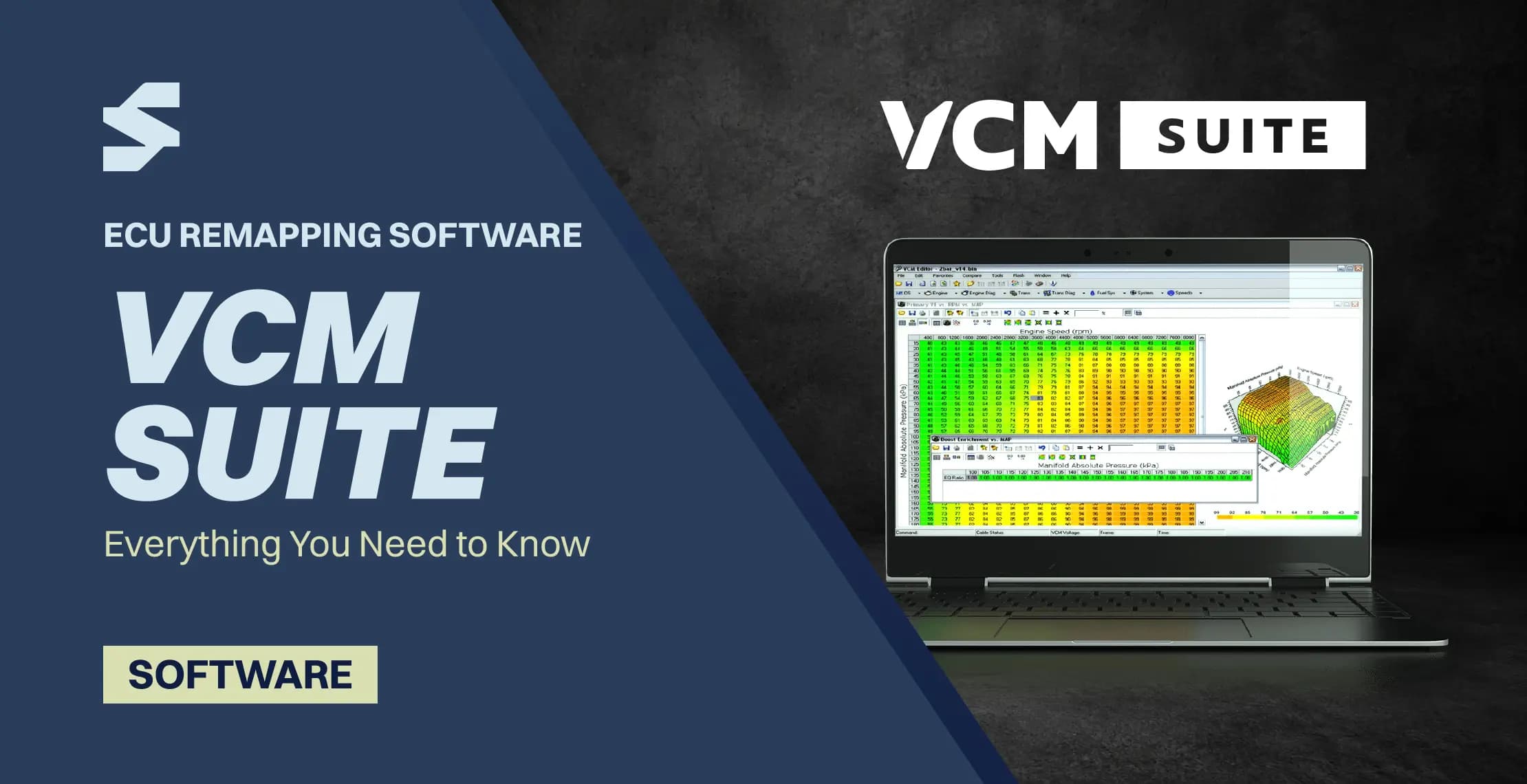
If you have ever researched vehicle tuning, especially American cars, you have probably heard the name HP Tuners many times. Perhaps on a specialized automotive forum, from a tuner, or even while searching for remapping solutions. In any case, this brand is considered one of the best-known names in the tuning industry.
This American company started operating in the early 2000s and has become one of the most important providers of tuning tools for American vehicles over the years. Today, thousands of professional tuners around the world use the company’s products to calibrate vehicle ECUs and TCUs.
However, what many people do not know is that when someone talks about HP Tuners, they are usually referring primarily to software called VCM Suite.
VCM Suite is a collection of software tools that allows users to read, edit, analyze, and write ECU and TCU files. Alongside this software, a hardware interface called MPVI is used to establish communication between the computer and the vehicle.
The importance of this becomes clear when we consider that factory calibrations are written for millions of vehicles. The manufacturer has to take into account different weather conditions, fuel quality, emissions regulations, and even the driving habits of different users. As a result, factory calibration is always a compromise between performance, fuel consumption, durability, and emissions.
VCM Suite is a tool that allows a tuner to modify this compromise based on the actual conditions of the vehicle. This is why it is now used in many projects, from Eco Tuning and Stage 1 to several-hundred-horsepower race cars.
What Exactly Does VCM Suite Do?
From the outside, tuning may seem like a simple process. A laptop is connected to the vehicle, a few minutes pass, and a new file is written to the ECU. However, behind this process is a series of complex operations that VCM Suite manages.
In the simplest definition, the software has four main functions:
- Reading ECU and TCU data
- Editing calibration files
- Writing the new file to the vehicle
- Recording and analyzing live data
Together, these four stages form the complete cycle of professional tuning.
1. Reading and Writing ECU and TCU Data
The first step in any tuning stage is reading or extracting the vehicle’s original file. This file contains hundreds or even thousands of different tables and parameters that control the behavior of the engine and transmission.
VCM Suite allows this information to be read through the MPVI interface. After reading the file, the tuner can save it and apply the required changes.
On many vehicles, this process is performed directly through the OBD2 port, while some newer and more advanced ECUs may require other methods, such as Bench Programming.
After the modifications are completed, the new file is written back to the ECU. The same process can also be performed on many TCUs, which is one of the major strengths of HP Tuners.
Supporting both ECU and TCU tuning allows the engine and transmission to be calibrated as a coordinated system, which is particularly important on modern vehicles.
2. Editing Calibration Tables
After reading the file, we move on to the most important part of the process: adjusting the tables.
Inside an ECU, there are hundreds of different tables that control engine and transmission behavior. These tables determine:
- How much fuel is injected?
- When ignition occurs?
- How much boost pressure is requested?
- How the throttle operates?
- At what engine speed the transmission changes gear?
- How torque limitations are applied?
VCM Suite displays this information in a structured and understandable way.
Unlike software such as WinOLS, which often displays much of the information in raw form, most tables in HP Tuners have already been identified and are presented to the tuner with specific names.
This makes the tuning process faster and safer on supported platforms.
On many turbocharged vehicles, a tuner does not work only on boost tables. A significant part of the process involves torque management, temperature limiters, protection strategies, and coordination between the engine and transmission.
3. Key VCM Suite Features and Tools
Many people may not know this, but VCM Suite is not a single software application. It is a collection of several different tools, each with a specific function, which we will discuss below.
VCM Editor
VCM Editor is the most important part of the suite.
All major ECU and TCU file modifications are performed in this environment. Here, you can open the original file, examine different tables, and apply the required changes according to your needs.
Another highly useful feature of the software is the Compare function. This feature allows two different files to be placed side by side and compared quickly. For example, you can compare an original file with a Stage 1 file and see exactly which parameters have been changed.
4. VCM Scanner; Data Analysis and Logging Tool
This software allows users to view and record live data and is considered one of the most powerful logging tools available on the market. In addition to standard ECU data, it can also connect to many external sensors and wideband sensors.
Through VCM Scanner, VCM Suite can record hundreds of different parameters, such as boost pressure, fuel pressure, intake air temperature, ignition timing, and more, in real time.
This information is recorded while driving and allows the tuner to see how the engine behaves under real-world conditions. This is why proper tuning should be based on data rather than simply on the driver’s impressions.
A vehicle may appear completely healthy and problem-free to the driver, while logging data may show that the engine is experiencing knock or entering protection strategies. This is particularly important for modified, turbocharged, and supercharged vehicles.
Why Is VCM Suite Popular Among Tuners?
The reason for its popularity is not simply the software’s features. In reality, a combination of extensive vehicle coverage, continuous development, a large user community, and professional features has made VCM Suite one of the industry standards in vehicle tuning.
One of the most important advantages of this platform is its continuous updates. As new ECUs and TCUs are introduced, the HP Tuners team usually adds support for new platforms to the software. This is particularly important for tuners working on newer vehicles.
In addition, thousands of tuners around the world use it. As a result, a large amount of technical information, practical experience, tested files, forums, and specialized training has developed around the software. For users, access to this collective body of technical and practical knowledge is a major advantage.
Which Vehicles Are Supported?
Most specialized tuning software focuses on only a few specific models. Although HP Tuners supports a wide range of different vehicles and engines, this coverage is not the same across all brands, and significantly greater access is available for American automotive brands compared with others.
Currently, a large portion of HP Tuners users are owners of GM, Ford, and Dodge vehicles.
Within the GM group, vehicles such as:
- Camaro
- Corvette
- Silverado
- Tahoe
- Yukon
- Cadillac CTS-V
- Pontiac GTO
can be mentioned.
The popular LS and LT engines, which are widely used around the world, are also extensively supported by HP Tuners.
In the Ford section, vehicles such as:
- Mustang
- F-150
- Ranger
- Explorer ST
as well as many vehicles equipped with EcoBoost and Coyote engines, are included in the supported platforms.
Within the Dodge and Chrysler family, popular platforms such as:
Charger
Challenger
Durango
Ram
along with Hemi and Hellcat engines, are also among the main platforms supported by this software.
In recent years, HP Tuners has also started supporting some European and Asian vehicles. However, as mentioned earlier, American vehicles remain its primary strength.
Which Vehicles Are Not Supported?
To be honest, VCM Suite is not the best choice for every vehicle.
Although its support coverage has expanded significantly over the years, many European tuning projects are still carried out using other tools.
For example, for many vehicles from:
BMW
Mercedes Benz
Audi
Volkswagen
Porsche
Volvo
ECU Tuners typically use WinOLS, ECM Titanium, or brand-specific tuning software.
For this reason, choosing the right tuning tool should always be based on the vehicle and ECU rather than simply on the popularity of a particular software.
ECU and TCU Coverage
Another feature of this software, as mentioned above, is that it not only supports and identifies ECU tables but also supports TCU files.
On newer vehicles, engine and transmission operation are directly interconnected, and tuning them simultaneously can provide significantly better results.
Furthermore, at higher tuning stages, increasing engine torque without adjusting the transmission calibration can cause problems such as improper gear changes, reduced durability, or even the activation of protection limiters.
This is caused by the significant difference between ECU and TCU values after tuning the ECU alone. This can result in transmission damage, poor remapping results, a lack of synchronization between the engine and transmission, and poor transmission response.
For this reason, in some cases, it is better to tune the engine and transmission simultaneously.
On many popular transmissions in the American market, such as:
- 6L80
- 6L90
- 8L90
- 10L80
- 10R80
This capability allows gear-shift speeds, clutch pressures, torque management, and many other parameters to be customized according to the level of modifications made to the engine.
VCM Suite vs. Competitors
HP Tuners vs. WinOLS
Whenever ECU tuning software is discussed, WinOLS is almost always mentioned. Many people who are new to ECU remapping and calibration assume that these two software platforms are direct competitors, but the reality is somewhat different.
HP Tuners and WinOLS can often achieve similar results, but their design philosophies are completely different.
VCM Suite is designed to provide direct access to identified calibration tables. When you open a file, the software already knows where the ignition table is located, where the torque limiter is, or how the boost control strategy is defined.
As a result, the tuner can work directly on the required parameters.
WinOLS, on the other hand, is primarily an environment for reverse engineering ECU files.
In many projects, the software does not automatically know where the maps are located. The tuner must identify the structure of the file using their own knowledge or with the help of DAMOS and A2L files.
For this reason, the learning curve of WinOLS is considerably steeper than that of HP Tuners.
This difference allows HP Tuners to provide a much faster workflow on supported vehicles. This is also one of the reasons why many American-car tuners tend to prefer HP Tuners.
On the other hand, WinOLS offers considerably greater flexibility.
If you are working with an unknown ECU or a specific platform, WinOLS will probably be the more suitable option. This is why many tuners working with European vehicles still consider WinOLS their primary tool.
Simply put, if your project involves a supported GM, Ford, or Dodge vehicle, VCM Suite will generally be faster, simpler, and more efficient.
However, if you are working with Bosch, Siemens, Continental, or Marelli ECUs found in European vehicles, WinOLS remains one of the most powerful options available.
At the time of writing this article, it is fair to say that there is still no single tuning tool that is the best choice for every vehicle and every project.
Every tool and software platform has its own strengths and weaknesses, and tuners generally choose their tools based on the vehicle, the ECU, and the objective of the project.
HP Tuners vs. EFI Live
Since we are discussing American vehicles, it is worth mentioning that EFI Live is considered one of the closest competitors to HP Tuners.
Both platforms provide extensive capabilities for editing ECU and TCU files and have been used by American tuners for many years. EFI Live is particularly popular on certain platforms, especially among users working with Duramax diesel engines.
HP Tuners vs. SCT
SCT and HP Tuners are both among the best-known tuning platforms for Ford vehicles, but they take different approaches.
SCT has been a primary choice for many Ford tuners for years and is still widely used for different types of projects, particularly when the goal is to use pre-made calibration files or dedicated flashing devices for end customers.
HP Tuners, on the other hand, focuses more on flexibility, access to a wider range of parameters, and advanced data-logging capabilities.
Many tuners prefer to adjust the calibration based on vehicle data logs rather than simply using pre-made files. In this area, VCM Suite provides more powerful tools.
In practice, if your goal is custom, data-log-based tuning, particularly on EcoBoost or Coyote vehicles, HP Tuners is generally considered the more complete and professional option.
However, SCT remains a reliable platform with a long history in the Ford market and can deliver excellent results on many projects.
Therefore, the final choice largely depends on the requirements of the project, the tuner's experience, and, to some extent, personalpreference. That said, if you are a professional tuner with sufficient knowledge and are not simply an end user of pre-made files, our recommendation would be HP Tuners.
When Is HP Tuners the Best Choice?
If your vehicle, or the vehicles you normally work on as a tuner, is included in the supported vehicle list, this software will generally be one of the best options available.
The combination of the following features has helped VCM Suite remain one of the leading platforms in the tuning market:
- Extensive coverage of American vehicles
- Powerful data-logging capabilities
- Access to both ECU and TCU
- A large user community
- Continuous software development
- Extensive educational resources
For GM, Ford, and Dodge, HP Tuners has effectively become an industry standard.
Remote Tuning with HP Tuners
One of the reasons HP Tuners has become increasingly popular in recent years is its ability to support remote tuning.
With this approach, the vehicle does not need to be physically present at the tuner's location. A significant part of the tuning process can be performed remotely over the internet.
First, the original stock ECU or TCU file is read and extracted from the vehicle. The file is then sent to the tuner. After reviewing the vehicle specifications, hardware modifications, fuel type, and project objectives, a new calibration is prepared.
The tuned file is then written back to the vehicle, followed by data logging to evaluate the performance of the engine and transmission.
For example, if a vehicle is equipped with a downpipe, intake, upgraded supercharger, or upgraded turbocharger, simply sending a pre-made file or relying solely on experience is not enough.
Parameters such as boost pressure, AFR, ignition timing, intake air temperature, and knock activity should be monitored through data logs. If necessary, the calibration should be revised multiple times until the desired final result is achieved.
A significant portion of the projects at Schiller Tuning is also carried out using this approach. Customers from different countries send their original vehicle files, the required data logs are recorded, and the calibration process is performed step by step based on the vehicle's live data.
This approach allows the final calibration to be tailored to the specific vehicle, installed hardware, and modifications that have been made.
As a result, many professional Stage 1, Stage 2, Flex Fuel, automatic transmission optimization, and even high-performance projects can now be completed remotely without requiring the customer to visit the tuner in person.
However, it is important to understand that this process should be performed by experienced professionals. Otherwise, improper calibration can cause significant damage to the vehicle's entire setup.
Is VCM Suite Suitable for Beginners?
One of the major advantages of this software compared with many other ECU tuning tools is its relatively easy-to-understand user interface. A user opening the software for the first time will find an environment where the tables and parameters are already identified and named.
This makes the initial learning process easier than with tools such as WinOLS.
However, it is important not to confuse an easier interface with an easier tuning process.
Changing a value in an ignition or boost table may take only a few seconds, but understanding its effects on exhaust gas temperature, knock, cylinder pressure, and engine durability requires knowledge and experience.
Many tuning-related failures are not caused by limitations in the software but by incorrect interpretation of the data.
It is important not to be misled by numbers in this game. Achieving impressive-looking numbers is often relatively easy. The real challenge is achieving a safe calibration while improving power and driving experience.
This requires considerably more knowledge than simply increasing or decreasing certain parameters randomly, or even based on experience without fully understanding how those parameters work.
Otherwise, there are plenty of remaps with impressive-looking numbers that can result in serious engine damage after only a few days or weeks.
ECU calibration based on data logging is not limited to AFR or boost. The tuner must simultaneously monitor the behavior of the fuel system, torque management, ECU protection strategies, intake air temperature, and dozens of other parameters.
For this reason, VCM Suite can be an excellent starting point for learning, but becoming a professional tuner requires study, experience, and a deep understanding of how modern engines operate.
Advantages and Disadvantages of VCM Suite
As mentioned earlier, no tuning tool is ideal for every vehicle and every project, and VCM Suite is no exception.
However, there are clear reasons why HP Tuners has become one of the most popular tuning platforms in the North American market over the past two decades.
One of the biggest advantages of VCM Suite is its direct access to identified ECU tables and parameters. Unlike software such as WinOLS, which often requires manual map identification or the use of DAMOS files, most importantparameters in HP Tuners are already defined.
This allows the tuner to spend more time on actual calibration and less time reverse-engineering the ECU file.
There is another interesting point worth mentioning here.
In general, VCM Suite provides a higher level of map identification and direct parameter access compared with similar software such as ECM Titanium and Race EVO.
The reason is that VCM Suite focuses primarily on American vehicles. As a result, the specialists at HP Tuners can dedicate more development time to a relatively smaller group of vehicles compared with platforms such as ECM Titanium and Race EVO.
ECM Titanium and Race EVO, on the other hand, cover a much wider range of vehicles and brands. Therefore, it is understandable that they have less development time available for highly detailed parameter definitions for specific functions such as speed limiters and other individual strategies.
Another major strength is the advanced data-logging capability of VCM Scanner.
Many professional tuners consider the quality of the logging and data-analysis tools in HP Tuners to be one of the main reasons for its popularity.
The ability to record dozens of parameters simultaneously, create custom charts, and connect additional sensors such as wideband AFR sensors means that the software is more than just an ECU flashing tool, it has become a complete vehicle performance analysis platform.
Simultaneous support for both ECU and TCU is another important advantage.
In many modern vehicles, increasing engine torque without revising the transmission strategies does not produce the desired results.
Having access to both controllers within a single software environment allows the tuning process to be more coordinated and precise. The large HP Tuners user community is another genuine advantage.
Thousands of tuners around the world use the software, resulting in a huge amount of educational material, practical experience, technical guides, and specialized information.
For many GM, Ford, and Dodge platforms, it is usually possible to find relevant educational resources or similar tuning experiences.
On the other hand, the HP Tuners licensing and credit system is one of its most significant disadvantages.
Each vehicle requires a specific number of credits to be activated, and these credits must be purchased separately.
As a result, the cost of using the software is not limited to purchasing the MPVI interface, and the overall cost increases as the number of vehicles increases.
Another limitation concerns vehicle coverage.
Although HP Tuners has added support for some European platforms in recent years, its primary strength remains American vehicles.
For many Bosch, Siemens, and Continental ECUs used in European vehicles, tools such as WinOLS still offer greater flexibility.
It should also be noted that, unlike some OEM or factory-level software, VCM Suite does not necessarily provide complete access to every strategy within every ECU.
On certain platforms, some tables or specific parameters may not be available or may only be editable to a limited extent.
Ultimately, it is important to remember that no matter how powerful the software is, the quality of the final result still depends on the tuner's knowledge, accurate analysis of data logs, and understanding of engine behavior.
VCM Suite is an extremely capable tool, but like any other tool, it delivers the best results when used by someone who understands how to interpret and work with the data.
Conclusion:
VCM Suite has established itself as one of the most capable ECU and TCU tuning platforms, particularly for American vehicles from manufacturers such as GM, Ford, Dodge, and Chrysler. Its biggest strengths are not limited to reading and writing calibration files. The combination of VCM Editor, VCM Scanner, ECU/TCU support, extensive parameter identification, and advanced data logging provides tuners with a complete environment for calibration and performance analysis.
One of the key advantages of VCM Suite is its relatively straightforward workflow. Compared with platforms such as WinOLS, where considerable knowledge may be required to identify maps and understand the structure of an ECU file, VCM Suite provides many supported parameters in an already organized and identifiable format. This can significantly reduce the time required to reach the calibration stage, especially on supported vehicles.
At the same time, VCM Suite is not a universal solution. Its strongest coverage remains focused on American vehicles, while many European platforms and ECUs may be better suited to tools such as WinOLS or other specialized software. The licensing and credit system should also be considered when evaluating the overall cost of the platform.
Most importantly, powerful software does not automatically produce a safe or professional calibration. VCM Suite provides the tools to modify parameters and analyze vehicle behavior, but the quality of the final result depends heavily on the tuner's technical knowledge, understanding of engine and transmission operation, and ability to interpret data logs correctly.
For experienced tuners working with supported platforms, especially GM, Ford, and Dodge vehicles, VCM Suite can be an extremely powerful and efficient solution. For beginners, it can provide a more accessible entry point into ECU calibration, but mastering the software is only the beginning. Understanding the engine, interpreting data, and knowing how to make safe calibration decisions are ultimately far more important than simply knowing which values to change.

About the author
