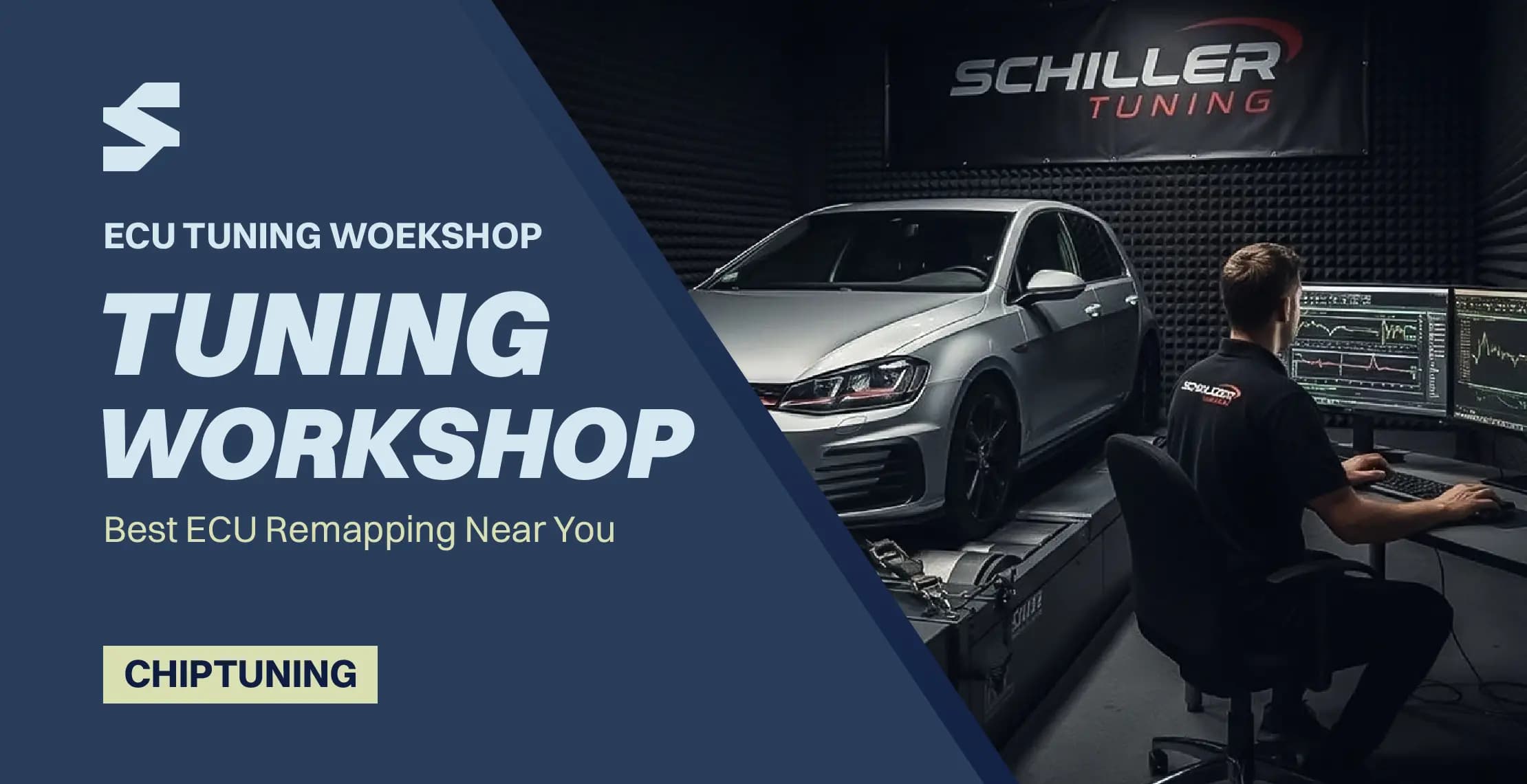
How to Find the Best ECU Remapping Near You & What Defines a Professional Dyno ECU Tuning Workshop
ECU remapping (Chiptuning) has become one of the most popular upgrades for modern vehicles, offering improvements in power, torque, throttle response, and sometimes ECU solutions like DPF and Adblue delete. However, the results of an ECU tune depend entirely on who does the tuning and how it is done. Choosing the wrong Chiptuning workshop and tuner can lead to poor drivability, engine damage, or reliability issues like limp mode. This article explains how to find the best ECU remapping service near you and clearly defines the difference between a standard tuning workshop and a professional ECU tuning facility, including the essential tools, software, knowledge, and procedures used by expert tuners. Finaly, we suggest you to use Schiller Tuning network for professional Chiptuning.
1. How to find a trustworthy ECU tuning shop?
1.1 Look Beyond Advertising and “Stage Numbers”
Many workshops promote themselves using terms like Stage 1, Stage 2, or custome tune. These labels are marketing terms and do not guarantee quality. Instead of focusing on advertised horsepower gains, focus on process, transparency, and technical capability.
1.2 Check Experience With Your Specific Engine
The best tuner for you is not necessarily the most famous one, but the one who has real experience with your engine platform. Ask questions such as:
• How many cars with this engine have you tuned?
• Is the tune custom or a generic file?
• Do you support stock and modified setups?
An experienced tuner understands factory ECU strategies, knock control logic, torque modeling, and thermal limits specific to your engine.
1.3 Verify Diagnostic and Logging Capability
A quality ECU remapping shop must rely on data, not guesswork. If a workshop does not perform pre-tune diagnostics or post-tune data logging, this is a major red flag. Proper logging confirms that AFR, ignition timing, boost pressure, intake air temperature, Exhaust Gas Temperature (EGT), and knock levels are within safe limits.
1.4 Reputation and Technical Feedback
Look for:
• Independent reviews (forums, owner groups, social media)
• Before/after dyno graphs
• Long-term customer feedback (not just first-day impressions)
Reliable tuners are known for consistency and reliability, not just peak numbers.
2. Standard vs Professional ECU Tuning Workshops
Not all tuning workshops are equal. Below is a clear comparison between a standard ECU tuning shop and a professional ECU tuning facility.
"Comparative Analysis: Technical Discrepancies Between Standard Tuning Shops and Engineering-Driven Professional Facilities"
| Engineering Benchmark | Standard Workshop | Schiller Certified Facility | E-E-A-T Impact |
|---|---|---|---|
| 🛠 Calibration Method | Generic File Flashing | Custom Engineering Logic | Expertise |
| 📊 Data Validation | Minimal to None | Pre & Post Dyno Logging | Experience |
| 🚀 Dyno Facility | Road Tuning Only | In-House Professional Dyno | Authoritativeness |
| 🌡 Thermal Safety | Factory Limits Only | EGT & Lambda Optimized | Trustworthiness |
| 📈 Support Level | Basic Installation | Ongoing Engineering Support | Trustworthiness |
3. Standard ECU Tuning Workshop (Basic Level)
A standard workshop usually offers basic ECU remapping services suitable for lightly modified or stock vehicles.
Characteristics of a Standard Workshop
• Uses pre-made or generic tuning files
• Limited customization based on fuel quality or environment
• Minimal data logging
• Focuses mainly on increasing drivability and fuel
Typical Tools in a Standard Workshop
• OBD flashing tools (basic) like Alientech KESS3 and Autotuner
• Entry-level ECU Remapping software like ECM Titanium
• Handheld diagnostic scanner Like LUANCH
• No in-house dyno (road tuning only)
Pros
• Lower cost
• Quick service
• Suitable for conservative Stage 1 tunes
Cons
• Limited safety margins
• Not ideal for modified or high-performance engines
• Relies on factory knock control instead of proper calibration
4. Professional ECU Tuning Workshop (Expert Level)
A professional ECU tuning workshop treats ECU remapping as engineering, not just file flashing. These facilities are designed for performance, safety, and long-term reliability.
Core Characteristics of a Professional Workshop
• Fully custom ECU calibration
• Engine-specific and modification-specific tuning
• Strong understanding of combustion, AFR, ignition timing, and torque modeling
• Emphasis on engine health and repeatable results
5. Essential Tools in a Professional ECU Tuning Workshop
5.1 ECU Tuning Software
Professional tuners use advanced calibration software such as:
• WinOLS
• ECM Titanium
• OEM-level ECU definition tools
• Manufacturer-specific tuning suites
These allow full access to fuel maps, ignition maps, boost control, torque limiters, lambda targets, and safety strategies.
5.2 ECU Reading and Flashing Tools
High-quality hardware is essential, including:
• Bench and boot-mode flashing tools
• OBD and direct ECU access tools
• Secure gateway bypass tools for modern ECUs
Professional workshops can safely read and write ECUs without corrupting data.
5.3 Chassis Dynamometer (Dyno)
A professional tuning shop ideally has an in-house dyno, such as:
• Dynojet
• Mainline
• Maha
A dyno allows:
• Controlled load tuning
• Safe WOT testing
• Accurate power and torque measurement
• Repeatable before/after comparisons
5.4 Wideband AFR System
Wideband oxygen sensors are mandatory for safe tuning. Professional workshops use:
• Permanent dyno-mounted widebands
• External wideband controllers
These systems provide accurate real-time AFR data, far more reliable than factory narrowband sensors.
5.5 Data Logging Equipment
Data logging is what separates professional tuning from guesswork. A pro tuner logs:
• AFR and lambda
• Ignition timing and corrections
• Knock sensor activity
• Boost pressure
• Intake air temperature (IAT)
• Exhaust gas temperature (EGT)
Logging is performed:
• Before tuning (baseline)
• During tuning
• After tuning for validation
5.6 Advanced Diagnostics Tools
Professional workshops use dealer-level diagnostic tools to:
• Read live sensor data
• Detect hidden fault codes
• Monitor ECU adaptation values
• Verify readiness monitors
This ensures the vehicle is healthy before and after tuning.
6. Importance of Data Logging After ECU Remapping
Post-tune data logging is critical for safety and reliability. A professional tuner will:
• Test the car under real driving conditions
• Verify AFR stability across RPM and load
• Ensure knock control is inactive or minimal
• Confirm boost targets match calibration
Without logging, a tune cannot be considered complete.
7. Final Advice When Choosing an ECU Tuner
The best ECU remapping near you is not defined by location alone, but by process, tools, and expertise. Choose a tuner who:
• Explains what they are doing
• Uses data to justify decisions
• Prioritizes engine safety over peak numbers
• Supports the tune after installation
A professional ECU tuning workshop may cost more, but it protects your engine, delivers consistent performance, and provides peace of mind.
In ECU tuning, the cheapest or fastest option is rarely the best. Precision, data, and experience are what truly define a professional tuner.
"Professional Integrity Standards: The Mandatory Engineering KPIs for Schiller Tuning Authorized Representatives"
| Key Performance Indicator (KPI) | Schiller Tuning Compliance | Why This Standard Matters |
| ⚙️ Bosch ME17/MED17/MG1US Expertise | ✅ Mandatory | Prevents ECU locking and firmware corruption. |
| 🧪 AFR & Lambda Real-time Monitoring | ✅ Mandatory | Ensures engine safety under peak load conditions. |
| 💾 Advanced ECU & TCU Cloning | ✅ Mandatory | Guarantees precise data recovery & hardware safety. |
| 📈 Dyno-Validated Calibration Files | ✅ Mandatory | Provides repeatable performance & long-term reliability. |
| 🖥 Proprietary Feature Calibration | ✅ Mandatory | Delivers advanced features like Sport Displays. |
Real-World Case Study: Peak Power vs. Engine Longevity by Schiller ECU Tuning
To illustrate the difference between "file-flashing" and "professional calibration," let’s look at a recent technical support case within the Schiller Tuning network involving a Volkswagen Golf GTI (2.0 TSI).
One of our partner workshops was aiming for maximum output on a Stage 2 setup. Initial dyno pulls were performed with a target Air-Fuel Ratio (AFR) of 13.0:1 at Wide Open Throttle (WOT).
The Conflict: At an AFR of 13.0, the engine produced its absolute peak horsepower on the dyno. While this number looked impressive on paper, our engineering team reviewed the data logs and noticed a dangerous trend: Exhaust Gas Temperatures (EGTs) were climbing rapidly toward the upper safety limit of the turbocharger and exhaust valves during high-RPM pulls.
The Schiller Tuning Solution: Although the car was making more power, we instructed the tuner to enrich the fuel mixture in the upper RPM range (adjusting the lambda targets). We sacrificed approximately 5-8 hp to ensure the EGTs remained within a safe operating window.
The Lesson: A standard tuner might have handed the keys back to the customer, boasting about the high dyno numbers. However, at Schiller Tuning, we believe that "Power is nothing without reliability." By choosing a slightly richer mixture, we protected the customer's turbocharger and engine internals from thermal fatigue. This is the hallmark of a professional ECU tuning philosophy: prioritizing the engine's long-term health over a "glory run" on the dyno
The Data Insight: At 13.0:1 AFR, the Golf produced a peak of 310 hp. While this looked great on the dyno graph, our engineering team analyzed the logs and found that Exhaust Gas Temperatures (EGTs) were rising dangerously fast. Running "lean" at high boost creates extreme heat that can melt piston crowns and damage turbocharger internals.
The Professional Adjustment: We instructed the tuner to enrich the mixture to 11.8:1 in the upper RPM range.
• Result: Power dropped slightly to 302 hp.
• Outcome: Even though we lost 8 hp, the engine is now safe for track use and long-distance high speed driving.
Schiller Philosophy: We prioritize the engine's long-term health over a "glory run" number. 300 hp that lasts 10 years is better than 310 hp that lasts 10 months.
Common Technical Failures: The High Cost of Improper Calibration
The integrity of an internal combustion engine is inextricably linked to the precision of its ECU calibration. Selecting an inexperienced tuner,or utilizing generic, non-validated map files, introduces catastrophic operational risks that extend far beyond mere performance loss. In high-performance diesel applications, incorrect fuel-to-air ratio management frequently leads to excessive smoke limiter manipulation, resulting in uncontrolled combustion temperatures and severe engine overheating or high EGT . This thermal imbalance not only accelerates the degradation of the exhaust after-treatment system, causing premature catalytic converter failure, but also places extreme stress on internal components like pistons and exhust valve . Under such conditions, uncontrolled knock (detonation) can occur, leading to structural failures such as fractured piston crowns and thermal fatigue of the cylinder head.
Furthermore, the complexity of modern ECU architectures, such as the Bosch MG1US series and the Continental SIMOS series, demands a sophisticated understanding of torque-based monitoring systems. If the calibration strategy fails to correctly map the torque monitoring structures, the ECU’s diagnostic logic will detect a discrepancy between the requested and actual torque delivery. This triggers intrusive torque intervention, often manifesting as "torque monitoring DTC" or "torque manipulation" fault codes, which force the vehicle into a permanent limp mode (torque reduction) where the engine fails to achieve throttle response or full power output. At Schiller Tuning, we strictly prohibit these "glory run" approaches, emphasizing that safe calibration must always operate within the ECU's calculated torque-monitoring window to prevent both mechanical failure and electronic system lockouts.
Engineering Insight: Common Technical Failures & Fault Codes Resulting from Substandard Calibration
Professional Analysis Shared by the Schiller Tuning Engineering Network
Real-World Diagnostic Examples: Torque Monitoring Interventions
To illustrate the sensitivity of these systems, consider the following real-world examples where improper calibration directly triggers torque-monitoring intervention:
-
BMW (Bosch MG1CS201): During aggressive Stage 2 calibration, failing to adjust the torque-limiter maps relative to the actual torque production triggers the
120308fault code (Charging pressure control: Switch-off as consequence), causing the vehicle to enter a permanent limp mode where throttle input is ignored by the ECU. -
Volkswagen/Audi (Continental SIMOS 18.1): When modifying the load request tables without correctly calculating the "Torque Calculation Map," the ECU frequently logs the
P0606(Control Module Processor) orP160B(Torque Management) codes, which locks the throttle body and restricts engine output to prevent perceived hardware damage. -
Mercedes-Benz (Bosch MED17.7.x): Incorrect modification of the ignition timing or boost pressure maps that leads to an "Implausible Torque Request" often results in the
P2263orP0069codes, leading to a massive loss of power as the torque-monitoring logic forces the engine into a safety state to preserve the drivetrain. -
VAG 2.0 TDI (Bosch EDC17CP20): In diesel applications, improper scaling of the "Smoke Limiter" and "Torque Request" maps often causes the
P0234(Turbocharger Overboost Condition) combined with a torque intervention fault, leading to severe lack of power and limp mode due to the ECU's inability to reconcile requested fuel injection mass with current torque monitoring variables.
Final Note – Schiller Tuning
For those who demand maximum performance with uncompromised reliability, we strongly recommend choosing ECU tuning workshops that are official representatives of Schiller Tuning, have been professionally trained by our engineers, or operate using Schiller Tuning’s standardized, dyno developed, and data validated calibration files.
All Schiller Tuning files are engineered through extensive dyno testing, real-world data logging, and strict safety margins, ensuring optimal AFR, controlled ignition timing, stable boost behavior, and long term engine protection. By working with workshops within the Schiller Tuning network, you benefit from proven tuning strategies, professional level calibration standards, and results that go beyond peak numbers delivering consistent, repeatable, and safe performance. Choosing Schiller Tuning means choosing engineering-driven ECU calibration, not guesswork
Technical References & Engineering Foundation
The calibration standards and diagnostic insights presented in this guide are derived from a multi-layered foundation of manufacturer-grade documentation and proprietary engineering research.
To ensure maximum safety and performance, our tuning protocols are cross-referenced with the following technical resources:
-
Bosch ECU Documentation (EDC/MED/MG1 Series): We strictly adhere to Bosch’s "Torque-Monitoring Logic" and "Combustion Strategy" manuals, ensuring that all calibration adjustments remain within the documented safety windows of the ECU’s internal architecture.
-
Continental SIMOS Engineering Data: Our SIMOS series calibration methodology is built upon Continental’s hardware-level diagnostics, ensuring that torque-limiter requests and load-management strategies maintain strict parity with factory diagnostic thresholds.
-
Siemens (VDO) & Delphi Calibration Standards: We utilize internal map-identification standards consistent with Siemens and Delphi engineering protocols, specifically regarding fuel-delivery timing and high-pressure rail management in diesel applications.
-
Schiller Tuning Proprietary Dyno-Library: All Schiller Tuning calibration files are validated through our private 14-year database of real-world dyno-testing and long-term EGT/AFR data logs, ensuring repeatable results that exceed generic industry standards.
-
SAE & ISO Automotive Diagnostic Standards: Our diagnostic procedures are aligned with ISO 14229 (Unified Diagnostic Services) to ensure that every modification is compatible with modern dealer-level diagnostic equipment and does not compromise vehicle readiness monitors.

About the author